
Description
Abstract – Monitor and Control of Greenhouse Environment System Using 8051
1. Introduction
Greenhouses are specialized agricultural structures designed to create controlled environments for plant growth. In a greenhouse, factors such as temperature, humidity, soil moisture, and light intensity significantly influence crop yield and quality. Traditionally, these parameters were monitored and adjusted manually, which required continuous human supervision and often led to inefficient management.
With the advancement of embedded systems and automation technology, it has become possible to monitor and control the greenhouse environment in real-time using microcontroller-based systems. This project, ?Monitor and Control of Greenhouse Environment System Using 8051,? is an embedded system designed to automatically regulate environmental parameters using sensors, actuators, and decision-making algorithms executed by an 8051-based microcontroller.
The system integrates:
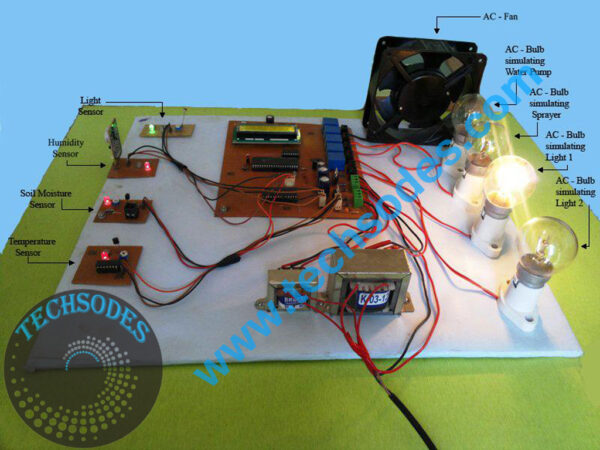
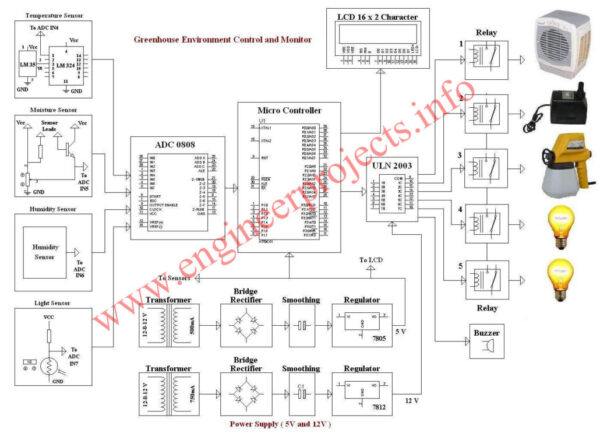
- Sensors (LM35, HR202, Soil Moisture Sensor, LDR) for real-time parameter detection.
- Signal conditioning and analog-to-digital conversion using ADC0808.
- Actuators (fans, heaters, irrigation pumps, shading systems) driven through ULN2003 relay drivers and relays.
- Regulated power supply to provide stable operating voltages.
By automating these processes, the system ensures optimal conditions for plant growth, reduces labor costs, and improves productivity.
2. System Overview
The system can be divided into three functional units:
- Monitoring Unit ? Gathers environmental data using sensors.
- Processing Unit ? The W78E052DDG microcontroller analyzes data and makes control decisions.
- Control Unit ? Actuators are triggered to adjust conditions within preset limits.
3. Core Controller ? W78E052DDG Microcontroller
At the heart of the system is the W78E052DDG, an enhanced 8051-compatible microcontroller. This chip is chosen because:
- It offers multiple I/O ports to connect sensors and actuators.
- It is compatible with external ADCs for analog input handling.
- It supports interrupts for time-critical tasks such as immediate control actions.
- It consumes low power, making it suitable for continuous operation.
Role in System:
- Data Acquisition: Reads sensor outputs via ADC0808.
- Decision Logic: Compares readings with threshold values stored in memory.
- Control Signal Generation: Sends signals to ULN2003 relay drivers to operate fans, pumps, or heaters.
- Automation Flow: Ensures that environmental conditions stay within desired ranges without manual intervention.
4. Sensors for Environmental Monitoring
4.1 LM35 Temperature Sensor
- Working Principle: The LM35 is a precision integrated-circuit temperature sensor whose output voltage is linearly proportional to the temperature in Celsius. It produces 10 mV per ?C.
- Application in Project:
The LM35 is placed within the greenhouse to measure ambient air temperature. Its analog output is sent to the ADC0808, then to the microcontroller. If temperature rises above the set maximum limit, the system activates cooling fans; if it falls below the minimum, the heater is switched on.
4.2 HR202 Humidity Sensor
- Working Principle: The HR202 is a resistive humidity sensor whose resistance changes with relative humidity. High humidity decreases the resistance; low humidity increases it.
- Application in Project:
The sensor’s resistance is converted to voltage via a simple resistor divider circuit. This voltage is read through the ADC0808. If humidity is too low, the system can activate a humidifier or irrigation spray; if too high, ventilation fans may be turned on to reduce moisture.
4.3 Soil Moisture Sensor
- Working Principle: Measures the volumetric water content of soil by detecting changes in electrical conductivity. Wet soil conducts electricity better than dry soil.
- Application in Project:
If the soil moisture level drops below the threshold, the microcontroller activates the irrigation pump via relay. This ensures that plants receive the required water automatically.
4.4 LDR (Light Dependent Resistor)
- Working Principle: The LDR changes resistance according to light intensity. In bright light, resistance is low; in darkness, resistance is high.
- Application in Project:
The LDR monitors sunlight entering the greenhouse. If the light intensity is too high, the system may activate shading mechanisms or close ventilation windows to prevent overheating.
5. ADC0808 ? Analog to Digital Conversion
Since the microcontroller can only process digital data, the analog signals from LM35, HR202, Soil Moisture Sensor, and LDR must be converted. The ADC0808 is an 8-bit, 8-channel ADC that can handle multiple inputs simultaneously.
Role in Project:
- Converts multiple sensor outputs into digital signals sequentially.
- Sends the converted values to the microcontroller for decision-making.
- Reduces the need for multiple ADC chips due to its multi-channel design.
6. Actuators and Control Mechanism
6.1 ULN2003 Relay Driver
- Function: The ULN2003 is a high-voltage, high-current Darlington transistor array that interfaces between the microcontroller (low voltage) and relays (high voltage).
- Role in Project:
Receives control signals from the microcontroller and switches relays that operate fans, pumps, heaters, or shading motors.
6.2 12V Relays
- Function: Act as electrically operated switches.
- Application:
- Fan control for cooling
- Heater control for warmth
- Pump control for irrigation
- Shade control for light regulation
7. Power Supply Unit
The system uses multiple voltage levels:
- 12-0-12/500mA Transformer: Steps down mains AC voltage.
- Bridge Rectifier: Converts AC to DC.
- 7805 Voltage Regulator: Provides 5V DC for the microcontroller and sensors.
- 7812 Voltage Regulator: Provides regulated 12V DC for relays and actuators.
8. System Operation Workflow
- Initialization: On power-up, the microcontroller initializes sensors and sets threshold values for temperature, humidity, soil moisture, and light.
- Continuous Monitoring: Sensors continuously send real-time data.
- ADC Conversion: All analog readings are converted to digital by ADC0808.
- Decision Making: Microcontroller compares readings with preset thresholds.
- Control Action:
- High temperature ? Cooling fans ON.
- Low temperature ? Heater ON.
- Low soil moisture ? Irrigation pump ON.
- Low light intensity ? Adjust shades or artificial lights.
- Feedback Loop: The system keeps adjusting until all parameters return within optimal ranges.
9. Advantages of the System
- Fully automatic, reducing labor costs.
- Real-time monitoring ensures plants grow in optimal conditions.
- Energy-efficient, as actuators operate only when needed.
- Can handle multiple environmental parameters simultaneously.
- Modular design allows for easy upgrades (e.g., adding CO? sensors).
10. Applications
- Commercial greenhouse farms.
- Research-based plant growth studies.
- Botanical gardens requiring precise control.
- Urban rooftop farming projects.
- Hydroponic and aquaponic farms.
11. Possible Future Enhancements
- Wireless Monitoring: Adding Wi-Fi or GSM modules for remote control.
- Data Logging: Storing historical sensor data for analysis.
- AI Integration: Machine learning algorithms for predictive control.
- Solar Power Supply: For energy independence in rural areas.
- Advanced Sensors: CO?, pH, and nutrient sensors for complete control.
12. Conclusion
The ?Monitor and Control of Greenhouse Environment System Using 8051? is an intelligent and efficient automation solution for agriculture. By integrating temperature, humidity, soil moisture, and light intensity monitoring with automatic actuator control, it ensures optimal growing conditions while minimizing human effort.
Its 8051 microcontroller-based design offers simplicity, reliability, and cost-effectiveness, making it suitable for real-world agricultural applications. The modular structure allows future upgrades, ensuring the system remains relevant with technological advancements.
This system represents a step toward smart agriculture, where environmental control is precise, responsive, and data-driven, ultimately leading to better crop yields and sustainable farming practices.


Reviews
There are no reviews yet.