

Description
Abstract:
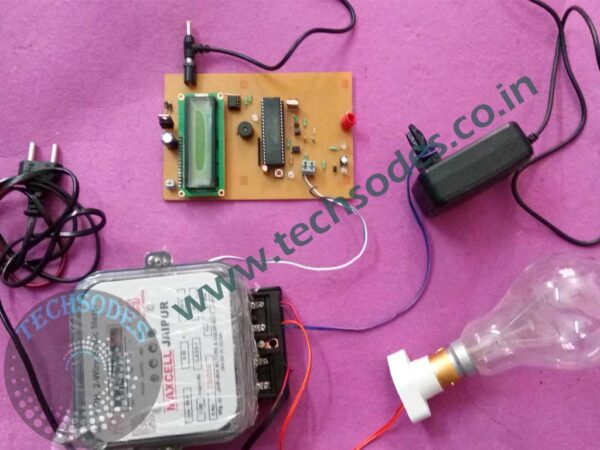
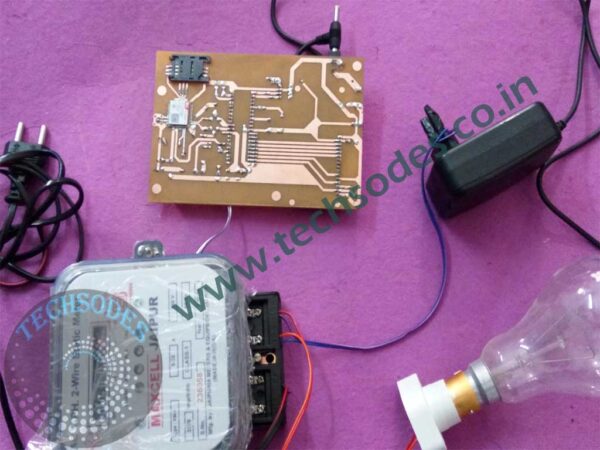
This project presents the design and implementation of a Simple GSM-Based Energy Meter Reading System using an AT89S52 microcontroller, intended to automate the process of electricity consumption monitoring and billing in domestic and industrial environments. Traditional electricity meters require manual meter reading and often suffer from inaccuracy, human error, and inefficiencies in billing. This project aims to address those issues by integrating GSM communication for automated data transmission, EEPROM storage for non-volatile data management, and a secure SMS-based control mechanism to allow remote administrative configuration.
System Overview
The system is built around the AT89S52 microcontroller, a popular 8051-family MCU, which serves as the core controller. It is interfaced with a digital energy meter that emits pulses from its call LED for every predefined unit of energy consumed (typically 3200 pulses per kWh). These pulses are captured using a PC817 optocoupler, which provides electrical isolation between the high-voltage energy meter and the low-voltage microcontroller circuit. Each pulse is treated as a unit increment and is counted by the microcontroller to calculate energy consumption in real time.
The current energy reading is displayed on a 16×2 LCD in units, which provides immediate visual feedback to the user. A buzzer is also included in the circuit for alerting the user for warnings, status updates, or confirmation of changes in system parameters.
GSM Communication for Remote Monitoring
The key highlight of this project is its GSM-based communication module, which enables the microcontroller to send energy readings directly to the user’s mobile phone via SMS, using the SIM800 GSM modem. This functionality eliminates the need for physical meter readings and allows energy providers or users to receive up-to-date consumption data remotely, regardless of location.
The system also supports SMS-based commands, allowing the admin to remotely configure or modify system settings. These include:
- Unit price settings
- Admin mobile number
- User mobile number
- EEPROM reset or data reload
- Security password updates
All SMS-based controls are password protected, ensuring that only authorized users (admin) can make changes to the system. Unauthorized or incorrectly formatted SMS messages are automatically rejected, and an alert message is sent back to the sender.
Memory and Data Storage
A 24C02 EEPROM (I?C-based) is used to store all essential parameters such as:
- Total energy units consumed
- Unit price set by the admin
- User and admin mobile numbers
- System password and authentication codes
This non-volatile memory ensures that data is retained even after power failure. Upon reboot, the microcontroller retrieves the last known state and resumes normal operation, including current energy readings and all configuration settings. This adds robustness to the design, making it suitable for real-world applications where reliability is critical.
Working Principle
- Pulse Detection: The call LED on the energy meter blinks based on energy usage. Each blink (pulse) is optically isolated and sent to the microcontroller as a countable digital input.
- Counting Logic: The microcontroller counts these pulses and calculates the energy consumed in real-time.
- LCD Display: The live unit consumption is displayed on a 16×2 LCD.
- EEPROM Update: Every significant change in units or settings is stored in EEPROM to maintain continuity.
- GSM Reporting: At a predefined interval or on admin request, the SIM800 GSM module sends an SMS to the user with the current meter reading and total cost.
- Secure automatic? SMS-based Reading Delivery to end users.
- Admin Control: The admin can send password-authenticated SMS commands to update settings remotely.
- Buzzer Feedback: A buzzer provides audio confirmation for critical operations like setting updates, resets, or data errors.
Features and Functionalities
- Real-Time Energy Monitoring via pulse counting from the digital meter.
- Remote Configuration of system settings using admin SMS commands.
- EEPROM-Based Data Storage ensures persistence through power failures.
- LCD Interface for real-time visualization of consumption.
- Buzzer Alerts for user feedback or error warnings.
- Mobile Number Configurability for both admin and user.
- Password-Based Access Control for SMS commands.
Advantages
- Eliminates Manual Meter Reading: Automates the billing process.
- Remote Monitoring: Users and providers can monitor consumption from any location.
- Cost Effective: Uses readily available low-cost components.
- Secure Control: Only authorized users can access or modify system parameters.
- Non-Volatile Memory Support: Prevents data loss after power cuts.
- Expandable: Can be extended to 3-phase systems or integrated with IoT platforms.
Applications
- Domestic electricity billing systems
- Industrial energy monitoring
- Smart grid integration
- Prepaid energy meters (with minor modifications)
- Government or utility remote monitoring projects
Future Enhancements
- Integration with IoT platforms like ThingSpeak or Blynk for real-time online monitoring.
- Use of touchscreen display for advanced user interaction.
- Real-time clock (RTC) for timestamped readings and logging.
- Web-based or mobile app interfaces for users.
- Solar energy consumption monitoring with bidirectional metering.
Conclusion
The Simple GSM-Based Energy Meter Reading System using 8051 is a practical and scalable solution for modernizing traditional energy metering systems. By integrating pulse detection, secure SMS communication, EEPROM data backup, and microcontroller-based logic, this system addresses the limitations of manual meter reading and enhances the reliability of energy monitoring and billing. Its modular design and password-based SMS configuration make it flexible for both home and industrial use cases. This project demonstrates how embedded systems can be effectively used to solve real-world utility challenges through automation, communication, and secure control.


Reviews
There are no reviews yet.