Description
Abstract
Laser-Based Highway Speed Checker with Alarm and Display
1. Introduction
Road accidents remain prevalent worldwide, and overspeeding remains one of the primary causes. Despite posted speed limit signs, many drivers exceed limits due to inattention or misjudgment. To address this critical safety issue, the Laser-Based Highway Speed Checker offers a reliable, low-cost, real-time solution. Designed for use along highways and busy roadways, this system accurately measures vehicle speed between two fixed points and triggers an alert if the speed exceeds the permissible threshold.
2. System Overview
The speed checker is built around two laser?LDR pairs positioned exactly 100 meters apart. As a vehicle passes through the first beam, the system starts timing. When it interrupts the second beam, timing stops. The elapsed time is captured using precise timers, and speed is calculated using the simple formula:
Speed?(km/h)=100?mTime?(s)?3.6text{Speed (km/h)} = frac{100 text{ m}}{text{Time (s)}} times 3.6
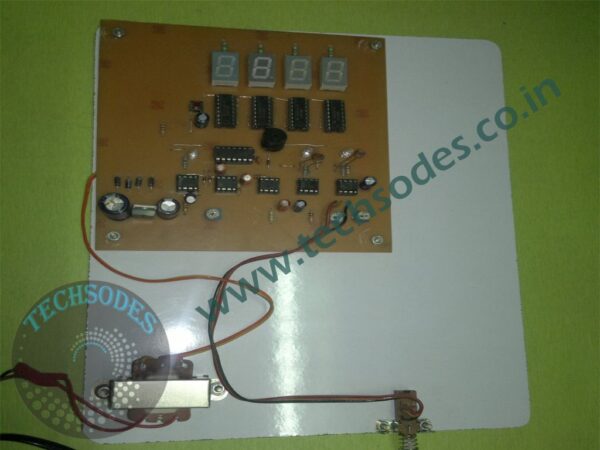
The measurement, converted into a digital count (where each unit represents 0.01 seconds), is displayed on 4-digit 7-segment displays. If the speed crosses a preset limit (e.g., 60 km/h), an audio alarm is triggered?providing an immediate alert to traffic enforcement personnel.
3. Functional Workflow
- Sensor Detection:
The first vehicle beam breaks the laser?LDR link, triggering a timer start. Upon crossing the second beam, the timer stops. - Time Counting:
A high-frequency clock (e.g., 100 Hz for 0.01 s resolution) allows precise measurement of elapsed time. - Speed Calculation & Display:
The timer?s result is directly mapped to the 7-segment display. For instance, ?600? indicates a 6.00 s interval, equating to approximately 60 km/h. - Alarm Activation:
If the elapsed time is below a user-defined threshold (indicating overspeed), a piezo buzzer sounds immediately. - Resetting:
A manual reset switch prepares the system for monitoring the next vehicle.
4. Key Components
- Laser Diodes & LDRs (x2): Positioned 100 m apart to detect passing vehicles
- High-Resolution Timer: Based on a 555 timer configured for stable and accurate counting
- Counters & 7-Segment Displays: Typically CD4026 counters with common-cathode 7-segment LEDs
- Alarm Buzzer: A piezo buzzer triggered when speed exceeds preset limits
- Power Supply: Step-down transformer, bridge rectifier, filter capacitor, and voltage regulators for stable DC power
- Reset Switch: To initialize the system after each vehicle detection
5. System Advantages
- High Accuracy: Fine 0.01-second time resolution allows accurate speed computation
- Cost-Effective: Built using inexpensive, readily available components (555 timers, counters, lasers, LDRs)
- Fast Response: Instant alert allows quick enforcement of speed limits
- Compact & Modular: Easy to install and maintain; suitable for highway deployment
- Educational Value: An excellent project to demonstrate practical application of timing circuits and vehicle safety solutions
6. Applications
- highway traffic monitoring stations
- school zones and urban areas with strict speed limits
- temporary patrol checkpoints where mobile monitoring makes sense
- traffic calming initiatives in construction zones or near sensitive locations
7. Future Enhancements
- Microcontroller Integration: Add programmable speed thresholds, logging, and remote alerts
- Photography Capture: Snapshot vehicles that exceed limits via camera trigger
- Wireless Notification: Send SMS or dashboard alerts in real-time
- Multi-Lane Coverage: Duplicate the setup per lane or use wide-beam sensors
- Digital Data Logging: Save speed data for analytics or automated ticketing purposes
8. Conclusion
The Laser-Based Highway Speed Checker is an elegant, reliable, and proven method for enforcing speed limits and improving road safety. By using dual laser?LDR sensors spaced at 100 meters, precise timers, visual display, and audible alert, the system offers real-time speed monitoring?ready for deployment on highways, school zones, or any area requiring traffic calming. This project exemplifies how simple electronics can yield meaningful contributions to public safety and traffic management.