

Description
8x8x8 LED Cube ? 3D LED Animation Display System
Abstract
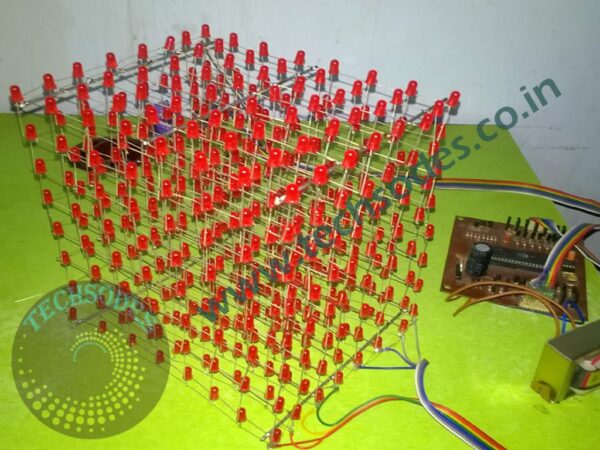
The 8x8x8 LED Cube is a visually striking electronic project that demonstrates the combination of precise hardware control and creative programming to produce dynamic 3D visual effects. Comprising 512 individual LEDs arranged in a cube-shaped matrix, the project leverages advanced multiplexing techniques to create stunning animations, wave effects, geometric transformations, and scrolling text in three dimensions.
In this implementation, the system is driven by a W78E052DDG microcontroller?a high-performance variant of the 8051 family?paired with BD139 (NPN) and BD140 (PNP) transistors for LED driving. A stable power supply circuit, including a 7805 voltage regulator, ensures reliable operation of the cube while maintaining LED brightness and microcontroller stability.
This project stands out due to its layer multiplexing approach, where only one LED layer is active at a time, but switching occurs so rapidly that the human eye perceives the entire cube as being lit simultaneously. This method drastically reduces power consumption and simplifies control circuitry, enabling intricate animations without requiring a dedicated connection to each LED.
The result is a compact, educational, and highly customizable display platform that can be programmed for endless visual patterns?making it equally suited for learning, artistic expression, exhibitions, and interactive installations.
1. Introduction
3D LED cubes have long been popular in electronics hobbyist circles due to their ability to transform abstract programming logic into tangible, visual art. Unlike a flat LED matrix, an LED cube provides spatial depth, enabling animations to exist within a volumetric space.
In the case of this 8x8x8 cube, 512 LEDs are wired in a matrix arrangement, allowing control over each individual point of light. The key challenge lies in designing both the hardware circuitry to drive hundreds of LEDs efficiently and the software algorithms that create appealing 3D animations.
This particular build uses the W78E052DDG microcontroller as the central processing unit, chosen for its fast execution, ample I/O pins, and familiarity with the 8051 instruction set. Transistors (BD139 and BD140) are employed to handle the higher current required by multiple LEDs, while the multiplexing technique allows the system to use far fewer control lines than the total number of LEDs.
2. Components and Their Roles
2.1 Microcontroller: W78E052DDG
- An 8-bit 8051-compatible MCU with enhanced performance.
- Features include multiple I/O ports, timers, and sufficient program memory for storing complex animation sequences.
- Responsible for:
- Sending control signals to the transistors.
- Activating specific LEDs in precise timing sequences.
- Managing animation algorithms and transition effects.
2.2 Transistors: BD139 (NPN) and BD140 (PNP)
- BD139 (NPN): Controls the cathode layers (8 total). Each NPN transistor sinks current from one horizontal layer of 64 LEDs.
- BD140 (PNP): Controls the anode columns. Each PNP transistor acts as a high-side switch to power specific vertical LED lines.
- Benefits of this arrangement:
- Prevents the microcontroller from being overloaded with LED current.
- Allows simultaneous activation of multiple LEDs in a layer.
2.3 Resistors
- Placed in series with LEDs to limit current, preventing LED damage.
- Values calculated based on:
- LED forward voltage.
- Desired operating current (typically 15?20 mA per LED).
2.4 Power Supply Circuit
- Transformer: 12-0-12 V, 500 mA ? steps down AC mains voltage.
- Bridge Rectifier: Converts AC to DC.
- Smoothing Capacitor (2200 ?F / 25V): Reduces voltage ripple.
- Voltage Regulator (7805): Provides regulated 5 V supply for the MCU and LEDs.
- Ensures constant brightness and protects components from voltage fluctuations.
2.5 LEDs
- 512 LEDs arranged in an 8x8x8 format.
- Each LED?s anode is connected through a PNP transistor line, and cathodes are grouped by layer to NPN transistors.
- Uniform brightness ensured by precise resistor selection and regulated supply.
3. Working Principle
3.1 LED Matrix Architecture
The cube is essentially an 8-layer LED matrix, each layer containing an 8×8 grid (64 LEDs). By combining layer selection with column control, any single LED can be addressed individually.
3.2 Layer Multiplexing
- Only one layer is active at any moment.
- The MCU cycles through all layers within milliseconds, refreshing the display so quickly that the human eye perceives the cube as fully lit (persistence of vision).
- This drastically reduces wiring complexity and power requirements.
3.3 Pattern Generation
- Animation sequences are stored in MCU memory.
- Each pattern consists of bitmaps representing LED states for each layer at each refresh cycle.
- Example animations:
- Wave motion flowing through cube.
- 3D spirals twisting upward or downward.
- Expanding/contracting cubes from center.
- Scrolling text through the cube volume.
- The refresh rate and transition speed are adjustable via software.
4. Power Supply Design
A stable and noise-free power source is critical for flicker-free LED operation.
- Transformer converts 230V AC to 12V AC.
- Bridge Rectifier converts AC to pulsating DC.
- Smoothing Capacitor eliminates most voltage ripple.
- 7805 Regulator steps down and stabilizes output to 5V.
- Decoupling Capacitors near the MCU ensure local stability during rapid LED switching.
5. Key Features
- High Visual Impact: True 3D animations viewable from multiple angles.
- Customizable Animations: Patterns stored in MCU can be updated or replaced.
- Energy Efficiency: Only part of the cube is active at any given instant.
- Educational Value: Demonstrates multiplexing, matrix control, and embedded programming.
- Expandable Design: Larger cubes (e.g., 10x10x10) or integration with wireless modules possible.
6. Advantages
- Educational Tool: Ideal for teaching concepts of digital electronics, microcontroller programming, and 3D visualization.
- Low Component Cost: Uses widely available transistors, resistors, and LEDs.
- Compact Control System: Multiplexing reduces control lines from 512 to manageable numbers.
- Artistic Applications: Suitable for art exhibits, interior d?cor, and event lighting.
- Durable and Serviceable: Modular layer construction allows for easy repairs.
7. Applications
- Exhibitions and Stage Shows: As a dynamic 3D light sculpture.
- STEM Education: Demonstrating electronics principles in schools and colleges.
- Advertising and Signage: Displaying logos or animations in public spaces.
- Art Installations: As part of interactive digital art exhibits.
- Prototyping Platform: Testing 3D visual algorithms for larger LED structures.
8. Future Enhancements
- Interactive Controls: Adding buttons, joysticks, or motion sensors to control animations in real-time.
- Audio Synchronization: Animations reacting to music beats.
- Wireless Programming: Using Bluetooth or Wi-Fi modules to upload patterns without direct wiring.
- Color Upgrade: Using RGB LEDs to create multi-color 3D effects.
- PC Interface: Streaming animation data from a computer to the cube for unlimited patterns.
9. Conclusion
The 8x8x8 LED Cube is a perfect fusion of electronics engineering and creative programming. Using W78E052DDG microcontroller, BD139/BD140 transistors, and a carefully regulated power supply, it achieves bright, flicker-free, and complex 3D animations.
Through multiplexing, the cube minimizes hardware complexity while maximizing visual output, making it not only a practical educational tool but also a captivating visual display. Whether used in classrooms, exhibitions, or personal projects, this LED Cube serves as a testament to the elegance and creativity possible in embedded electronics.

Reviews
There are no reviews yet.