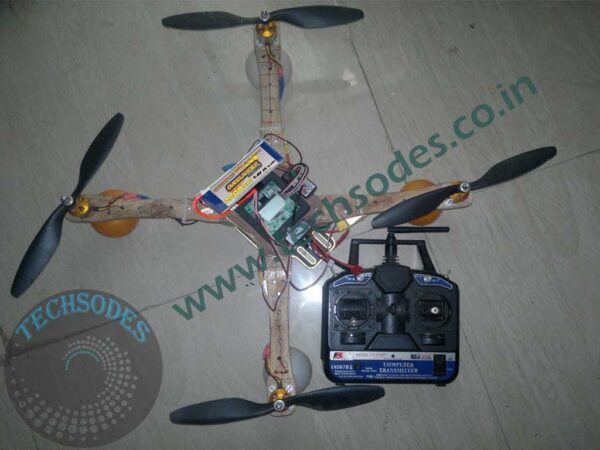
Description
Abstract: Quadcopter Drone Using KK2.1.5 Flight Controller
Unmanned Aerial Vehicles (UAVs), commonly referred to as drones, are revolutionizing the world of aerial surveillance, photography, delivery systems, and defense. Among these, quadcopters?multi-rotor UAVs with four propellers?are especially popular due to their structural simplicity, agility, and ability to hover and perform complex maneuvers. This project presents the design, construction, and working of a Quadcopter based on the KK2.1.5 flight controller, integrating essential components such as Flysky FS-CT6B 2.4GHz 6-channel radio control, 1000KV brushless DC motors, SimonK Electronic Speed Controllers (ESCs), a 2200mAh LiPo battery, an HD camera, and a video transmission (TX) module.
The KK2.1.5 flight controller serves as the brain of the quadcopter, receiving inputs from the remote control and translating them into precise motor commands. The KK2.1.5 is equipped with an Atmel Atmega644PA microcontroller, an LCD screen for real-time configuration, and built-in sensors including gyroscopes and accelerometers. This controller simplifies the process of balancing and stabilizing the quadcopter during flight, enabling both manual and assisted control modes. The LCD interface eliminates the need for connecting the board to a computer for tuning, making in-field configuration easier and quicker.
The Flysky FS-CT6B 2.4GHz 6-channel transmitter and receiver pair provides robust and interference-resistant control, allowing the pilot to manipulate throttle, yaw, pitch, and roll. The six available channels are utilized to control not only the flight dynamics but also auxiliary functions such as camera activation or flight mode switching. The transmitter works on frequency-hopping spread spectrum (FHSS) technology, ensuring a reliable communication link over extended ranges with minimal latency.
To generate thrust and enable aerial movement, the quadcopter employs four 1000KV brushless DC motors. These motors are chosen for their optimal balance between speed and torque, providing sufficient lift to carry the drone along with its payload (camera and transmitter). The motors are connected to SimonK ESCs, which are high-performance speed controllers programmed with firmware optimized for fast throttle response and smooth motor operation. The ESCs interpret the signals from the KK2.1.5 and vary the speed of the motors accordingly, enabling lift, directional movement, and stability control.
Powering the entire system is a 2200mAh 3S LiPo (Lithium Polymer) battery, which provides the high current required for the brushless motors and the flight controller. The LiPo battery offers an ideal weight-to-capacity ratio, ensuring a decent flight time of approximately 8 to 12 minutes, depending on payload and flight style. Battery safety and proper voltage monitoring are crucial, as LiPo batteries can be sensitive to over-discharge or overcharge conditions. To ensure flight safety and battery life, a low voltage buzzer or alarm is typically integrated with the setup.
An important feature of this quadcopter is its capability for aerial video capture and real-time transmission. A lightweight HD camera is mounted on the frame to record high-quality footage. For live video streaming, the system includes a 5.8GHz video transmitter (TX module), which sends real-time footage to a ground receiver or display unit. This setup transforms the quadcopter into a First Person View (FPV) drone, enhancing its utility in surveillance, remote inspection, and immersive flight experiences. The video feed is transmitted with low latency, providing the operator with a bird?s-eye view and more precise control in complex environments.
The entire frame of the quadcopter is constructed using lightweight materials such as carbon fiber or fiber-reinforced plastic, ensuring structural durability while keeping the weight to a minimum. The “X” configuration of the quadcopter is used to achieve symmetry and balanced flight. Landing gear is added to protect the camera and motors during take-off and landing.
In terms of functionality, the quadcopter exhibits the ability to take off vertically, hover in place, move in all directions (forward, backward, sideways), and rotate along its vertical axis. These movements are achieved through variations in the speed of the four motors?throttle increases all motor speeds for lift; pitch and roll are managed by speeding up and slowing down opposite pairs of motors; yaw is controlled by adjusting the torque differential between clockwise and counterclockwise spinning motors.
Calibration and tuning are crucial to achieving stable flight. Before initial flights, the ESCs are calibrated to synchronize their response to throttle inputs. The KK2.1.5 controller is configured using its onboard LCD and buttons to set the motor layout, sensor calibration, and PID values (Proportional, Integral, Derivative). These PID values help fine-tune the responsiveness and stability of the drone during flight. Incorrect tuning can lead to instability, oscillations, or sluggish response, hence careful testing is performed in a controlled environment.
This quadcopter project blends multiple engineering disciplines?electronics, control systems, communication, mechanical design, and embedded programming. It provides a practical learning experience in configuring electronic components, understanding flight dynamics, tuning sensors, and handling real-world challenges like signal loss, wind disturbance, vibration damping, and power management.
Applications and Future Enhancements
The current design makes the quadcopter suitable for several real-world applications, including:
- Aerial photography and videography for events, journalism, or filmmaking
- Surveillance and security monitoring over inaccessible areas
- Search and rescue operations, where terrain may be difficult or dangerous for humans
- Agricultural field inspection and environmental monitoring
- Educational and research purposes to study UAV technology
Further enhancements can be implemented in the future to increase its autonomy, range, and intelligence:
- GPS Integration: Adding a GPS module would enable autonomous navigation, waypoint tracking, and return-to-home (RTH) functions in case of signal loss.
- Telemetry System: A telemetry module can send real-time data (altitude, GPS position, battery level) to a ground control station for better monitoring.
- Gimbal System: A motorized gimbal can be used to stabilize the camera, ensuring smooth and jitter-free footage regardless of drone movement.
- Obstacle Avoidance Sensors: Ultrasonic, infrared, or LIDAR sensors can enhance the drone’s safety and allow semi-autonomous navigation by detecting and avoiding obstacles.
- Autonomous Control via Ardupilot or PX4: For advanced mission planning and autonomous flying, more advanced controllers with open-source software can be used.
Conclusion
The development of this quadcopter using the KK2.1.5 flight controller, Flysky FS-CT6B, and supporting hardware demonstrates a cost-effective and educational platform for understanding and building UAV systems. Despite its simplicity compared to high-end commercial drones, it offers impressive capabilities in terms of manual control, real-time video transmission, and flight stability. The modular architecture allows future expansion and integration of advanced features like GPS, telemetry, and AI-based object tracking.
This project not only enhances technical skills in drone engineering but also opens up opportunities for innovation in multiple industries. With the growing demand for UAVs in commercial, industrial, and research sectors, such hands-on experience can be invaluable for students, hobbyists, and professionals alike.