

Description
Abstract – Home Automation Using Cell Phone
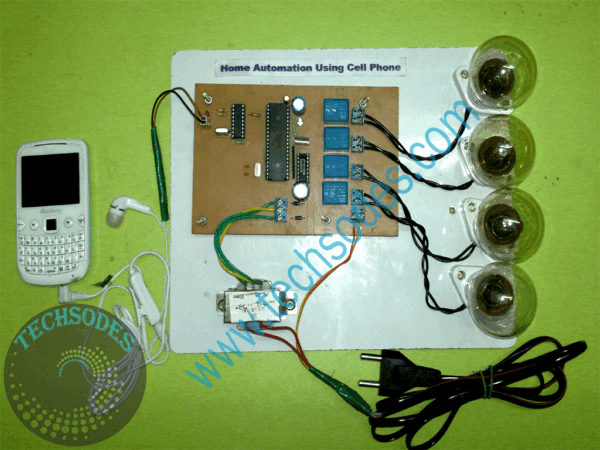
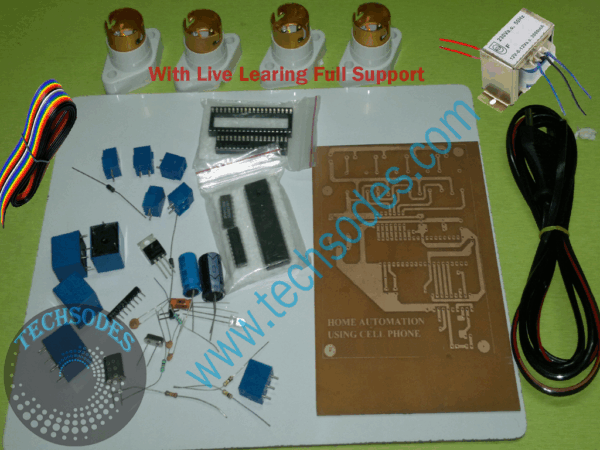
The Home Automation Using Cell Phone project is a microcontroller-based system designed to control home appliances remotely through a mobile phone. Instead of relying on traditional remote controls or expensive smart home systems, this design uses the Dual Tone Multi-Frequency (DTMF) signaling method that is standard in telecommunication systems. The advantage of this approach is that it can be operated from any location in the world where mobile network coverage is available.
The system enables the user to control electrical devices?such as bulbs, fans, televisions, and other household equipment?by simply dialing a dedicated mobile number and pressing specific keys. Each key corresponds to a unique appliance control command (ON or OFF). The project uses an AT89S52 microcontroller (part of the 8051 family) to process decoded DTMF signals, and the ULN2003 relay driver IC to control relays connected to the appliances.
The core functionality ensures that even if the user forgets to switch OFF devices before leaving the house, they can easily control them remotely, thereby improving energy efficiency, convenience, and security. The system is cost-effective, highly reliable, and does not require an internet connection?making it accessible for rural and urban users alike.
1. Introduction
Home automation has traditionally been associated with expensive, internet-enabled smart systems. However, in many regions?especially rural areas?high-speed internet or advanced smart devices are not available or affordable. In such cases, mobile phone-based control using DTMF tones offers a practical and robust alternative.
This project uses a secondary mobile phone connected to the system through its audio jack (headphone output). When the controlling user calls this mobile, the DTMF tones generated by pressing keys on their own phone are received, decoded, and translated into ON/OFF commands for specific devices.
2. System Overview
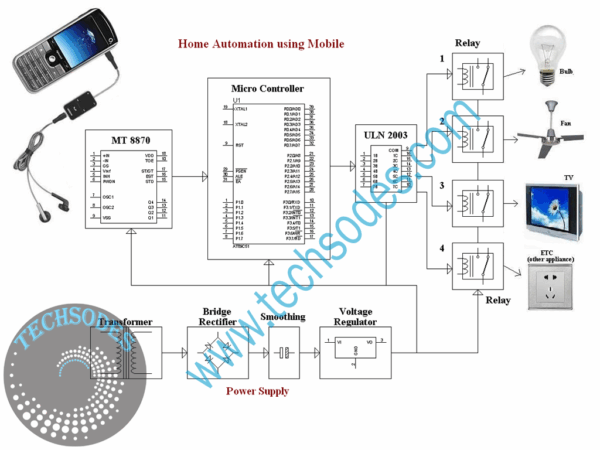
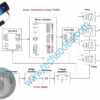
The Home Automation Using Cell Phone project comprises four main functional blocks:
- Mobile Phone Interface
- A standard mobile phone is permanently connected to the system via its headphone output.
- This mobile acts as the receiver of DTMF commands from the user.
- DTMF Decoder
- Uses MT8870 DTMF Decoder IC to convert received tone signals into 4-bit binary output.
- Each key press from the caller corresponds to a unique binary code.
- Microcontroller Unit (MCU)
- The AT89S52 microcontroller receives the binary data from the MT8870 and matches it with preprogrammed instructions to identify which appliance to control.
- It sends control signals to the ULN2003 relay driver.
- Relay Control Stage
- ULN2003 relay driver IC interfaces the low-power signals from the microcontroller to high-power relays that switch the AC appliances ON or OFF.
3. Working Principle
The working process follows these steps:
- User Initiates Call
- The controlling user (caller) dials the mobile number of the phone connected to the system.
- DTMF Tone Reception
- When the call is received, pressing any numeric key on the caller?s phone generates a specific DTMF tone.
- Example: Pressing ‘1’ sends a tone of two combined frequencies, unique to that key.
- DTMF Decoding
- The MT8870 IC converts the tone into a 4-bit digital code.
- This code is sent to the microcontroller.
- Microcontroller Processing
- The AT89S52 compares the received code with its lookup table stored in program memory.
- It determines which appliance should be toggled.
- Relay Activation
- The microcontroller sends a signal to the ULN2003, which energizes the relay corresponding to that appliance.
- The relay either connects or disconnects the appliance from the power supply.
- Device Control Feedback
- The system can be enhanced to send an acknowledgment via a buzzer or LED indicator to confirm the action.
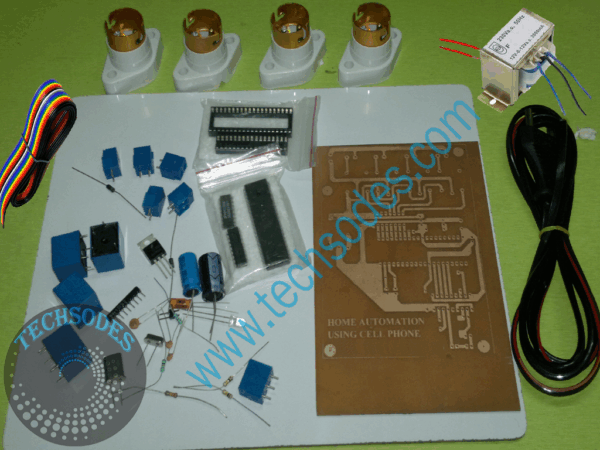
4. Hardware Components
4.1 AT89S52 Microcontroller
- 8-bit MCU from the 8051 family.
- Features:
- 8 KB Flash memory
- 256 bytes RAM
- 32 I/O pins
- Three 16-bit timers
- Serial communication capabilities
- Role: Interprets binary commands from the DTMF decoder and controls appliance relays.
4.2 MT8870 DTMF Decoder
- Converts tone pairs from telephone keypads into 4-bit binary codes.
- Detects all 16 standard DTMF characters (0?9, *, #, A?D).
4.3 ULN2003 Relay Driver IC
- 7-channel Darlington transistor array.
- Can drive relays directly from microcontroller output pins.
4.4 Relays
- Electromechanical switches used to control high-voltage AC appliances.
- Each relay is dedicated to one appliance.
4.5 Mobile Phone
- Any GSM mobile with a headphone jack can be used.
- No special modifications required.
4.6 Power Supply
- Regulated +5V DC for MCU and decoder circuit.
- Separate AC supply for appliances.
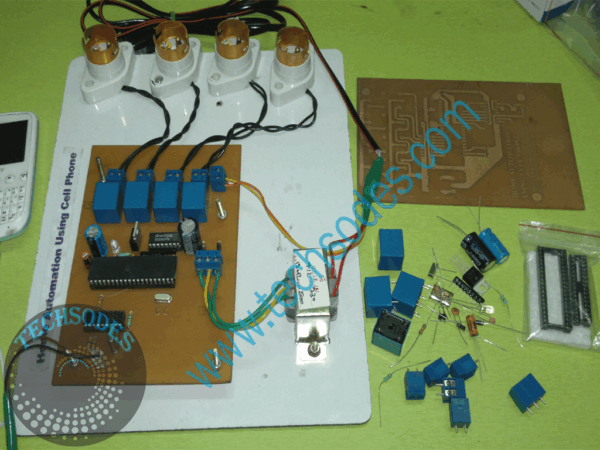
5. Circuit Operation
- The MT8870?s output pins (Q1?Q4) are connected to the MCU input pins.
- The MCU?s output pins are connected to the ULN2003 inputs.
- ULN2003 outputs are wired to relay coils, which in turn control the AC load.
- The common ground ensures proper signal reference between all blocks.
6. Key Mapping Example
| Mobile Key | Binary Output | Controlled Device |
|---|---|---|
| 1 | 0001 | Light 1 ON |
| 2 | 0010 | Fan ON |
| 3 | 0011 | Light 2 ON |
| 4 | 0100 | TV ON |
| 5 | 0101 | All ON |
| 6 | 0110 | Light 1 OFF |
| 7 | 0100 | Fan OFF |
| 8 | 1000 | Light 2 OFF |
| 9 | 1001 | TV OFF |
| 0 | 1010 | All OFF |
7. Applications
- Home Appliances ? Lights, fans, air conditioners, and TVs can be controlled remotely.
- Hotel Rooms ? Room lighting and cooling systems can be managed from reception.
- Shops & Showrooms ? Lighting or display units can be operated without physical presence.
- Industrial Systems ? Machinery or pumps can be turned ON/OFF remotely.
8. Advantages
- Works with Any Mobile Phone ? No special hardware needed for the user.
- Worldwide Access ? Works anywhere with mobile network coverage.
- Cost-Effective ? Uses basic, easily available components.
- High Reliability ? DTMF decoding is stable and resistant to noise.
- Energy Saving ? Appliances can be switched OFF remotely to reduce wastage.
9. Limitations
- Requires a dedicated mobile phone for the receiver end.
- Call charges apply for every control action.
- Not suitable for real-time control of rapidly changing devices.
- No direct feedback to the user unless additional communication modules are added.
10. Future Enhancements
- Add GSM module for SMS-based control and status updates.
- Add password protection to prevent unauthorized access.
- Add feedback system to confirm device status.
- Integration with IoT platforms for hybrid control via mobile network and internet.
- Expandable design to control more appliances.
11. Conclusion
The Home Automation Using Cell Phone project is a practical, affordable, and effective approach to remote appliance control. It combines the robustness of DTMF signaling with the simplicity of microcontroller-based switching to provide a reliable home automation solution that works without internet dependency.
The ability to operate devices from virtually anywhere in the world makes it highly useful for both domestic and commercial purposes. Its cost-effectiveness and low hardware requirements make it an attractive option for energy-conscious and convenience-seeking users alike.


Reviews
There are no reviews yet.