
Description
Remote-Controlled Hovercraft Using ATmega328 and 433 MHz Wireless Link
Abstract
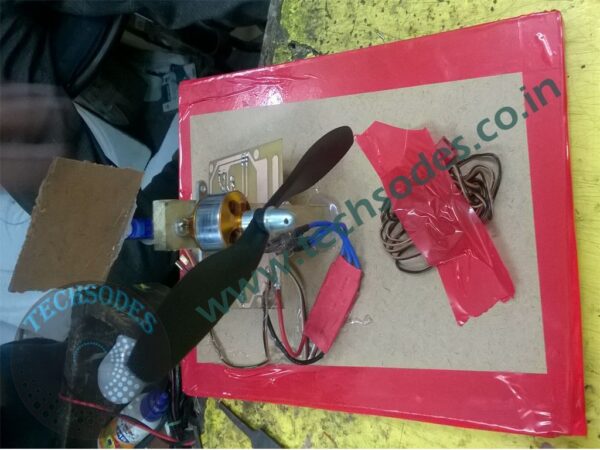
This project presents the design and implementation of a remote-controlled hovercraft that uses 433 MHz RF communication for control, an ATmega328 microcontroller for onboard processing, a BLDC motor with ESC for thrust generation, and a servo motor for steering. By combining principles of aerodynamics, embedded control, and wireless communication, the system achieves smooth, responsive, and precise hovercraft navigation over flat surfaces.
The remote-control system uses HT12E (encoder) and HT12D (decoder) ICs for serial data transmission and reception over a 433 MHz RF transmitter/receiver pair. Control commands sent from the transmitter are encoded by HT12E and wirelessly transmitted to the hovercraft, where HT12D decodes them for the microcontroller.
The ATmega328 interprets these commands and drives the propulsion and steering mechanisms. The propulsion system uses a Brushless DC (BLDC) motor connected to an Electronic Speed Controller (ESC) for high-efficiency thrust, while a 90g servo motor mounted at the rear adjusts the thrust direction for steering. The hovercraft design eliminates wheel-ground friction by using an air cushion, improving maneuverability and speed.
The system is powered by a lightweight battery pack for portability, and its control system is optimized for low-latency response, making it suitable for both educational demonstration and hobbyist applications.
1. Introduction
Hovercrafts are unique vehicles that move over surfaces by floating on a cushion of air, significantly reducing friction compared to traditional wheeled vehicles. This makes them capable of operating over multiple terrains such as smooth floors, water surfaces, and even slightly uneven ground.
In this project, the hovercraft is designed to be controlled wirelessly using a radio frequency (RF) link. The remote-control transmitter sends steering and throttle commands to the hovercraft in real time. A microcontroller-based control system then interprets the commands and adjusts the thrust and steering accordingly.
The design objective was to create a hovercraft that is:
- Lightweight yet powerful enough to achieve smooth gliding motion.
- Responsive to user commands with minimal delay.
- Cost-effective by using widely available components.
- Educational by combining aerodynamics, electronics, and embedded programming.
2. System Overview
The project consists of two main units:
2.1 Transmitter Unit (Remote Controller)
- HT12E Encoder IC: Converts parallel input signals (control buttons or joysticks) into serial data format.
- 433 MHz RF Transmitter Module: Sends the encoded data wirelessly to the hovercraft.
- Power Supply: A small battery (e.g., 9V) powers the transmitter and encoder.
2.2 Receiver Unit (Hovercraft)
- 433 MHz RF Receiver Module: Receives wireless data from the transmitter.
- HT12D Decoder IC: Converts serial data back into parallel control signals.
- ATmega328 Microcontroller:
- Reads decoded control inputs.
- Sends PWM signals to ESC for BLDC motor speed control.
- Sends PWM signals to servo motor for steering.
- BLDC Motor + ESC: Generates thrust for forward motion.
- 90g Servo Motor: Adjusts rear airflow direction for steering.
- Battery Pack: Powers the onboard electronics, motor, and servo.
3. Working Principle
3.1 Communication and Control Flow
- User Input: The operator moves joysticks or presses buttons on the transmitter.
- Encoding: HT12E encodes the inputs into a serial signal.
- Wireless Transmission: The 433 MHz transmitter sends the encoded data to the hovercraft.
- Reception: The 433 MHz receiver on the hovercraft picks up the signal.
- Decoding: HT12D decodes the signal back into parallel logic levels.
- Microcontroller Processing: ATmega328 processes the control logic:
- Throttle commands ? PWM output to ESC ? BLDC motor speed changes.
- Steering commands ? PWM output to servo motor ? changes thrust direction.
- Mechanical Response:
- BLDC motor pushes air to generate forward motion.
- Servo motor rotates the airflow nozzle to steer the hovercraft left or right.
4. Propulsion and Steering Mechanism
4.1 BLDC Motor with ESC
- The BLDC motor is chosen for its high thrust-to-weight ratio and smooth operation.
- The ESC (Electronic Speed Controller) receives PWM control signals from the ATmega328 and regulates the three-phase power to the motor.
- This system ensures precise and efficient speed control.
4.2 Steering with 90g Servo Motor
- The servo motor is mounted to control the orientation of the thrust nozzle.
- By redirecting airflow left or right, the hovercraft can turn without the need for wheels.
- The servo?s movement is controlled by the microcontroller?s PWM output.
5. Electronic Design
5.1 RF Communication Modules (433 MHz)
- Operates in the ISM (Industrial, Scientific, and Medical) band, license-free for hobby use.
- Provides sufficient range for small-scale hovercraft operation.
5.2 HT12E / HT12D Pair
- HT12E encodes 4-bit parallel data + 8-bit address into serial data stream.
- HT12D decodes received data back into parallel signals for processing.
5.3 ATmega328 Microcontroller
- Handles PWM generation for ESC and servo.
- Interprets control commands from the decoder IC.
- Offers real-time response to user input.
6. Power System
The hovercraft uses a Li-Po or NiMH battery pack to provide power for both control electronics and propulsion.
- Advantages: Lightweight, rechargeable, high current capability.
- The ESC is powered directly from the battery to provide sufficient current to the BLDC motor.
- The microcontroller and servo are powered via a 5V regulator for stable operation.
7. Mechanical Design Considerations
- Base Material: Lightweight foam or acrylic to minimize weight.
- Air Cushion: Generated by the thrust airflow escaping beneath the craft?s skirt.
- Skirt Design: Flexible material that traps air under the craft, allowing it to glide.
- Center of Gravity: Positioned for balance to prevent tipping.
8. Features of the System
- Full Wireless Control: Allows steering and speed adjustment from a distance.
- Low Latency: Immediate response to control inputs.
- High Efficiency: BLDC motor provides powerful thrust with minimal power loss.
- Simple User Interface: Easy to operate using standard joystick or push-button controls.
- Modular Design: Components can be upgraded individually.
9. Advantages
- Educational Value: Covers RF communication, microcontroller programming, and aerodynamics.
- Cost-Effective: Uses readily available components.
- Lightweight and Portable: Easy to transport and operate in small indoor/outdoor areas.
- Scalable Design: Can be adapted for larger hovercraft models or autonomous navigation.
10. Applications
- STEM Education: Demonstrates wireless control and embedded systems in action.
- Hobby Projects: Engages electronics enthusiasts in combining mechanical and electrical engineering.
- Prototype Testing: Platform for experimenting with new control algorithms or autonomous navigation.
- Entertainment and Competitions: Can be used in RC vehicle races and demonstrations.
11. Future Improvements
- Speed and Direction Feedback: Adding sensors to monitor hovercraft movement.
- Camera Module: For first-person view (FPV) control.
- Bluetooth/Wi-Fi Control: Alternative wireless systems for smartphone control.
- Autonomous Navigation: GPS or ultrasonic sensors for path planning.
- Dual BLDC Motors: Independent control for improved maneuverability.
12. Conclusion
The Remote-Controlled Hovercraft presented here demonstrates the successful integration of RF communication, embedded control, and aerodynamics into a single functional platform. By using HT12E/HT12D ICs for reliable data transmission, an ATmega328 microcontroller for intelligent control, and a combination of BLDC propulsion with servo-based steering, the system achieves smooth and responsive movement.
Its modular and adaptable design ensures that it can serve as a valuable educational project, a fun hobbyist build, or a base for further research in wireless control and hovercraft technology. The balance of low-cost components with high performance makes it an ideal demonstration of practical engineering and innovation.

Reviews
There are no reviews yet.