
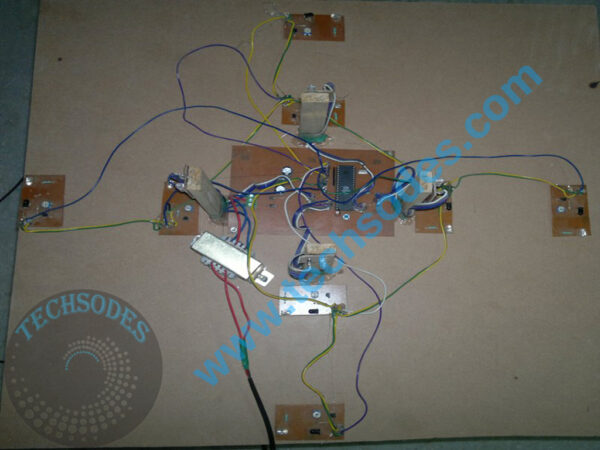
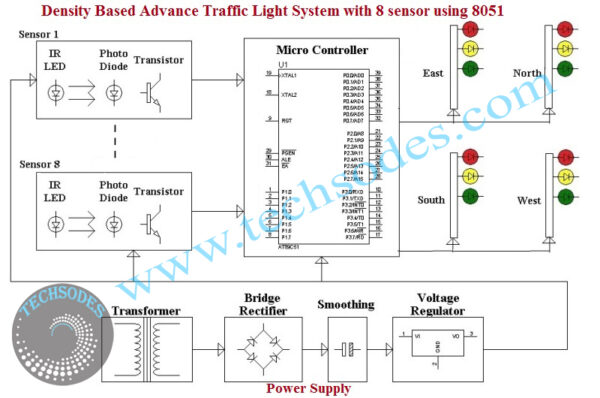
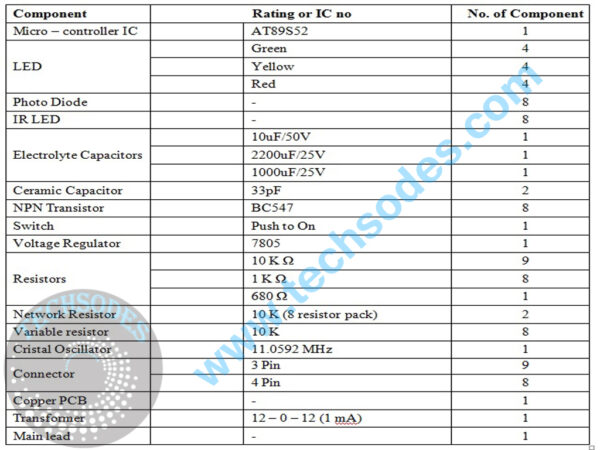
Description
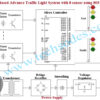
Abstract ? Density-Based Advanced Traffic Light System with 8 IR Sensors using 8051 Microcontroller
1. Introduction
Traditional traffic light systems operate on a fixed time cycle, where each lane gets a green signal for a predetermined period regardless of actual traffic conditions. This often leads to time wastage, unnecessary waiting, increased fuel consumption, and higher emissions?especially when one lane is empty while others remain congested.
To solve this problem, we propose a Density-Based Advanced Traffic Light System that dynamically controls signal timing based on real-time vehicle density detection using IR (Infrared) sensors. By incorporating two IR sensors on each of the four sides of an intersection (total 8 sensors), the system intelligently adjusts signal timings, improving traffic flow and reducing delays.
2. System Overview
Our design uses two IR sensors per side:
- First IR Sensor ? Vehicle Presence Detection
- Installed at the beginning of each lane’s waiting area.
- Detects whether any vehicle is present.
- If no vehicle is detected, the system skips the green phase for that lane, moving directly to the next lane, thus saving time for other directions.
- Second IR Sensor ? Density Measurement
- Placed further behind in the lane to check the number of vehicles queued.
- If vehicles are detected by both IR sensors, the lane is considered high-density and the green light duration is doubled (e.g., 2 minutes).
- If only the first sensor detects vehicles but the second does not, the lane is low-density, and the normal green duration (e.g., 1 minute) is applied.
This dual-sensor approach ensures fair and efficient allocation of green light time depending on actual congestion.
3. Working Principle
The AT89S51 microcontroller (from the 8051 family) is the core controller. It constantly monitors all eight IR sensors and decides the signal flow:
- Lane Scanning: The controller checks the first IR sensor of the current lane.
- Traffic Absence: If no vehicle is detected, it immediately moves to the next lane without activating the green signal.
- Traffic Presence: If detected, the second IR sensor is checked.
- Density Decision:
- High density (both sensors detect): Extended green time to clear more vehicles.
- Low density (only first sensor detects): Normal green time allocation.
- Continuous Operation: The process repeats for all lanes, ensuring real-time adaptive traffic control.
4. Advantages
- Efficient Traffic Management: Automatically adjusts green light duration based on real-time density.
- Reduced Waiting Time: Empty or low-density lanes don?t cause unnecessary delays.
- Fuel & Emission Reduction: Shorter idling times reduce fuel usage and CO? emissions.
- Simple and Reliable: IR sensors are cost-effective, easy to install, and low-maintenance.
- Scalable & Upgradable: Can be integrated with additional sensors or IoT modules for smart city applications.
- Improved Road Safety: Heavy traffic lanes get more clearance time, reducing accident risk.
5. Real-Life Application Potential
This system is suitable for urban intersections, high-traffic zones, and smart city infrastructure where traffic flow varies greatly during the day. The use of IR sensors ensures accurate detection both in daylight and at night, making it reliable in diverse weather conditions when properly shielded.
By combining low-cost hardware with intelligent signal control algorithms, the Density-Based Traffic Light System offers a practical, efficient, and sustainable solution for modern traffic management.


Reviews
There are no reviews yet.