
Description
Abstract – Sun Tracking System for Solar Panel
The Sun Tracking System for Solar Panel is an automated mechanism designed to keep solar panels oriented toward the sun throughout the day, thereby maximizing the absorption of solar radiation and enhancing energy output. Unlike fixed solar panels, which are positioned at a constant angle and lose efficiency during early morning and late afternoon, a sun tracker ensures optimal alignment by following the sun?s movement from east to west and adjusting for seasonal variations.
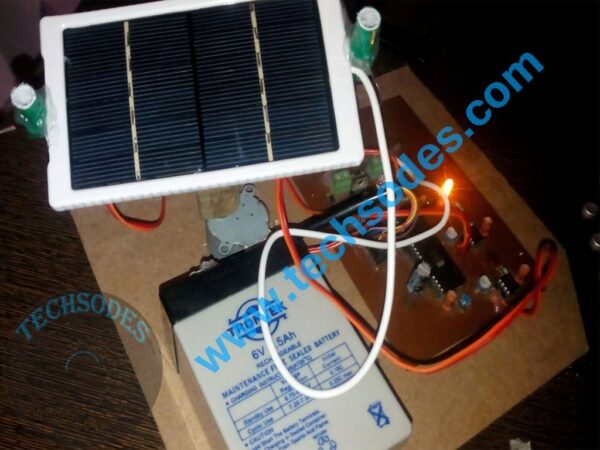
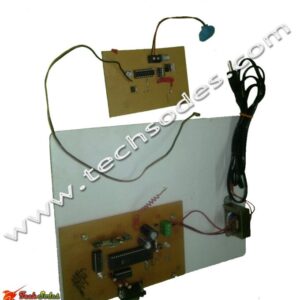
This system uses light-dependent resistors (LDRs) as sensors to detect sunlight intensity and a stepper motor as an actuator to rotate the panel accordingly. The controller processes the sensor data and determines the required movement, ensuring the panel is always at the most efficient angle. The result is a substantial increase in overall energy collection, making the system ideal for both small-scale and large-scale solar energy applications.
1. Introduction
The demand for renewable energy is steadily increasing due to rising energy costs and environmental concerns. Among renewable energy sources, solar energy is one of the most promising, given its abundance and sustainability. However, the efficiency of a solar panel depends heavily on its orientation with respect to the sun.
A fixed-position solar panel is typically optimized for maximum energy collection at solar noon, but during other times of the day, sunlight hits the panel at an angle, reducing the amount of energy captured due to the cosine effect. This limitation can be overcome by using a solar tracking system, which continuously adjusts the panel?s orientation to ensure it faces the sun directly.
2. Basic Concept
The sun emits light composed of two primary components:
- Direct Beam ? Carries about 90% of solar energy; highly directional and most useful for power generation.
- Diffuse Light ? Carries about 10% of energy, scattered in all directions due to atmospheric particles and clouds.
To maximize energy capture, the panel must face the direct beam for as much of the day as possible. Even small deviations from the optimal angle can result in significant energy losses. A sun tracker minimizes these deviations by dynamically adjusting the panel?s position.
3. Types of Solar Trackers
Solar trackers are generally categorized into:
- Single-Axis Trackers ? Rotate along one axis (usually east-west) to follow the sun?s daily movement.
- Dual-Axis Trackers ? Adjust both east-west and north-south angles, accounting for seasonal changes in the sun?s elevation.
The project described here focuses on a single-axis system for simplicity and cost efficiency, but can be upgraded to dual-axis for maximum performance.
4. System Components
The main components of the Sun Tracking System are:
4.1 Sensors
- Light Dependent Resistors (LDRs):
LDRs are used to sense light intensity. Two or four LDRs are placed in a specific arrangement with a physical divider between them, creating a differential light detection system. When the sunlight intensity is uneven between the LDRs, the system detects misalignment and adjusts accordingly.
4.2 Controller
- Microcontroller (e.g., 8051 or Arduino):
The microcontroller reads signals from the LDRs, compares the intensity values, and decides the direction of movement. It generates control signals for the motor driver.
4.3 Motor Driver Circuit
- L293D Motor Driver IC:
This IC acts as an interface between the low-power microcontroller output and the high-power stepper motor. It enables forward and reverse rotation based on control inputs.
4.4 Stepper Motor
- A stepper motor is used for precise control of angular movement, ensuring accurate positioning of the panel without overshooting.
4.5 Mechanical Structure
- The panel is mounted on a rotating frame connected to the motor via gears or a belt drive.
4.6 Power Supply
- A regulated DC power supply provides necessary voltage to sensors, controller, and motor driver.
5. Working Principle
The working of the system can be summarized in the following steps:
- Sensing Sunlight:
LDRs continuously sense the sunlight intensity. When both LDRs receive equal light, the panel is aligned with the sun. - Error Detection:
If one LDR receives more light than the other, the system interprets this as misalignment. - Signal Processing:
The microcontroller processes the difference between LDR readings and generates control signals. - Motor Movement:
The motor driver receives control signals and moves the stepper motor in small steps until both LDRs detect equal intensity again. - Continuous Adjustment:
This process runs continuously during daylight hours, keeping the panel aligned as the sun moves.
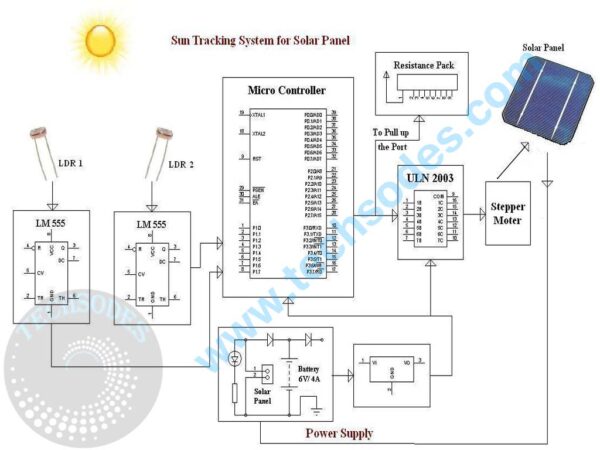
6. Block Diagram Description
A typical block diagram for this system consists of:
- Sensors (LDRs) ? Microcontroller ? Motor Driver ? Stepper Motor ? Solar Panel
- Power Supply Unit powering all components.
The feedback loop ensures that after every movement, new LDR readings are taken to check alignment.
7. Advantages
- Increased Energy Output: Captures more energy than fixed panels, especially during mornings and evenings.
- Efficient Space Usage: More energy from the same number of panels.
- Cost-Effective: Increases efficiency without increasing panel count.
- Scalable: Can be applied to both small home systems and large solar farms.
8. Disadvantages
- Initial Cost: Higher upfront cost due to sensors, motors, and control circuits.
- Maintenance: Moving parts require periodic servicing.
- Weather Dependence: Cloudy days may reduce the benefit compared to fixed systems.
9. Applications
- Residential solar energy systems
- Agricultural irrigation systems powered by solar
- Remote telecom towers
- Off-grid rural electrification
- Solar-powered street lighting
10. Efficiency Considerations
The efficiency gain of a sun tracker varies by location and season, but studies show:
- Single-axis trackers can increase energy yield by 25?35%.
- Dual-axis trackers can achieve up to 40% or more.
This gain can significantly improve the return on investment for solar systems.
11. Seasonal Tracking
In addition to daily movement, seasonal changes in the sun?s elevation angle can be addressed by:
- Manual tilt adjustments every few months.
- Adding a second axis for automatic vertical adjustment.
12. Future Enhancements
- Dual-Axis Upgrade: For maximum sunlight capture year-round.
- Weather Monitoring: Integrating wind and rain sensors to protect the panel during storms.
- Battery Storage: Combining with solar batteries for 24/7 power availability.
- IoT Integration: Remote monitoring and control via smartphone or web application.
13. Conclusion
The Sun Tracking System for Solar Panel is a practical and efficient solution to improve solar energy harvesting. By integrating simple components such as LDRs, a microcontroller, and a stepper motor, the system can continuously align the panel with the sun?s position, significantly increasing daily and annual energy output. Though it requires an initial investment and periodic maintenance, the long-term benefits in terms of higher power generation make it a valuable addition to any solar installation.


Reviews
There are no reviews yet.