
Description
Abstract ? Metal Detector using Three Transistors
1. Introduction
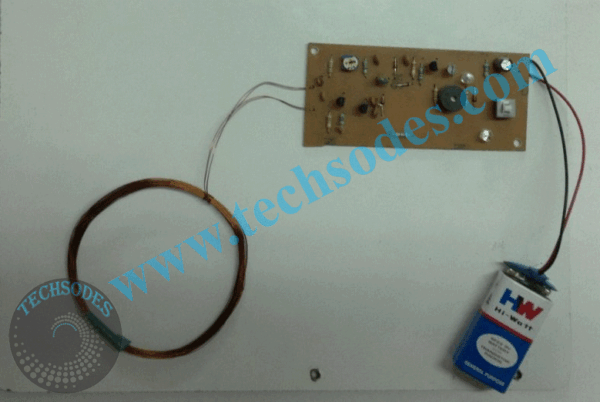
A metal detector is an electronic instrument specifically designed to detect the presence of metallic objects in its proximity. These devices have become indispensable in areas ranging from security screening at public places to treasure hunting, archaeological exploration, and industrial safety inspections. The project presented here focuses on a low-cost, portable, and highly efficient metal detector built using only three transistors.
By reducing the number of components, the design ensures affordability, ease of construction, and low power consumption, making it ideal for beginners, hobbyists, and even real-world small-scale security applications.
Unlike microcontroller-based systems, which require programming and complex circuitry, this analog transistor-based design works on a straightforward principle?detecting changes in an oscillating magnetic field caused by nearby metals and converting those changes into an audible or visual alert.
2. Principle of Operation
The operation of this three-transistor metal detector is based on electromagnetic induction. The heart of the device is a search coil that creates an alternating magnetic field when current flows through it.
- Step 1 ? Oscillation Generation:
A pair of transistors are configured as an oscillator, driving the search coil with an AC signal. This causes the coil to continuously generate an alternating magnetic field. - Step 2 ? Metal Interaction:
When a conductive metal object (such as iron, copper, aluminum, etc.) comes close to the coil, it disturbs this magnetic field. This disturbance induces eddy currents in the metal object. - Step 3 ? Magnetic Field Change:
The eddy currents generate their own magnetic field, which interacts with the coil?s original field, slightly altering the coil?s inductance and, in turn, the oscillator frequency or amplitude. - Step 4 ? Signal Detection:
The third transistor in the circuit acts as a detector and amplifier, converting these frequency/amplitude changes into a form that can drive an audio buzzer, earphone, or LED indicator. - Step 5 ? User Indication:
The user receives feedback in the form of a tone change (audible) or a needle/LED movement (visual), with the intensity or pitch increasing as the detected object gets closer.
3. Circuit Description
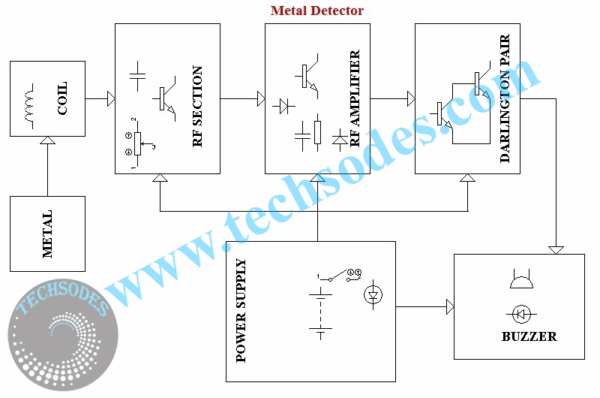
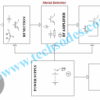
The three-transistor metal detector is divided into three functional stages:
Stage 1 ? Oscillator Stage
- Components: Two general-purpose NPN transistors (e.g., BC547, 2N3904).
- Function: Generates a high-frequency oscillation using the search coil and associated capacitors.
- Working: The coil and capacitor form a tuned LC circuit, and the transistors provide positive feedback to sustain oscillations.
Stage 2 ? Detection Stage
- Components: The third transistor.
- Function: Detects changes in the oscillation parameters caused by metal interference.
- Working: The detection transistor amplifies the small signal changes and converts them into a usable DC signal for the output stage.
Stage 3 ? Output/Alert Stage
- Components: Buzzer or audio transducer, and optionally an LED.
- Function: Provides a clear alert to the user when metal is detected.
- Working: The buzzer emits a tone whose frequency or volume changes with the proximity of the metal.
4. Component List
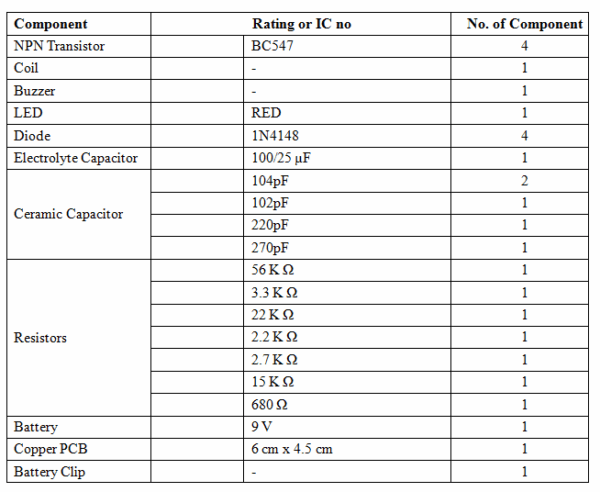
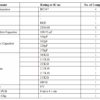
| Component | Specification | Quantity |
|---|---|---|
| Transistor | BC547 or similar | 3 |
| Resistors | Various values (e.g., 1k?, 10k?, 100k?) | As required |
| Capacitors | 100nF to 100?F (for tuning and filtering) | As required |
| Search Coil | 50?200 turns of 30 SWG enameled copper wire | 1 |
| Buzzer / Audio Output | Piezo buzzer or small speaker | 1 |
| Power Supply | 9V battery | 1 |
| Miscellaneous | PCB, switch, wires, casing | ? |
5. Coil Construction
The coil is the most critical part of the design, as its size and winding determine the detection range and sensitivity.
- Diameter: Typically 10?15 cm for handheld use.
- Wire Gauge: 30 SWG enameled copper wire.
- Turns: 50 to 200 turns, depending on frequency requirements.
- Mounting: The coil should be fixed securely to the base of the detector casing for consistent performance.
6. Working Procedure
- Power ON the device using the switch; the oscillator starts generating an alternating magnetic field through the coil.
- Sweep the search coil close to the ground or over objects.
- When a metallic object enters the magnetic field, the oscillator frequency shifts.
- The detection stage senses this shift and triggers the output buzzer.
- The closer the object, the faster or louder the tone?allowing the user to pinpoint its position.
7. Applications
- Security Screening: Detect concealed weapons or metallic contraband at schools, offices, and events.
- Treasure Hunting: Locate coins, jewelry, and relics buried in soil.
- Construction Safety: Identify hidden pipes, nails, or metal rods inside walls.
- Industrial Use: Detect metal fragments in food or raw materials during quality control.
- Educational Projects: Demonstrates the principle of electromagnetic induction for students.
8. Advantages
- Simplicity ? The entire circuit uses only three transistors, making it easy for beginners to build.
- Low Cost ? Components are inexpensive and widely available.
- Portability ? Lightweight design, easily powered by a 9V battery.
- Low Power Consumption ? Can run for hours on a single battery.
- Versatility ? Can detect a variety of metals, both ferrous and non-ferrous.
- Ease of Repair ? Fewer parts mean easy troubleshooting.
9. Limitations
- Detection Range: Limited to short distances (a few centimeters to ~15 cm).
- Metal Differentiation: Cannot distinguish between types of metals.
- Environmental Sensitivity: Performance can be affected by surrounding electromagnetic interference.
10. Future Improvements
- Increased Range: By optimizing coil size and using higher-quality capacitors.
- Metal Discrimination: Adding circuitry to identify ferrous vs. non-ferrous metals.
- Visual Meter Output: Including an analog or digital meter for depth indication.
- Rechargeable Power Supply: To make it more sustainable.
11. Conclusion
The Three-Transistor Metal Detector is a simple yet effective tool for detecting metallic objects in close range. It serves as a cost-effective alternative to commercial detectors while demonstrating the fundamental principle of electromagnetic induction.
With its low power requirement, lightweight build, and ease of assembly, this project is highly suitable for educational purposes, DIY hobbyists, and low-scale security applications. By making small modifications?such as improving coil design or adding output filtering?the performance can be significantly enhanced.
Ultimately, this design proves that even with just three transistors, it?s possible to create a reliable and functional metal detection device without the need for microcontrollers or complex ICs.

Reviews
There are no reviews yet.