Description
Abstract: 7?40 GSM-Based LED Notice Board Using PIC
In today’s world of digitized communication, the need for smart and remotely accessible information display systems is rapidly increasing. Traditional notice boards often fall short when it comes to real-time updates, remote access, and flexibility. To overcome these limitations, this project presents a GSM-based LED notice board system using a single-line 7?40 LED matrix. It is controlled via SMS and built using a PIC microcontroller, SIM800 GSM module, and 74LS595 shift registers. This low-cost, compact, and efficient system is ideal for use in shops, institutions, public entry points, industrial areas, and other compact spaces where information needs to be displayed prominently and updated remotely.
The main functionality of the system revolves around displaying SMS messages received through a GSM module. These messages are verified using a password mechanism before being displayed. The message can be shown in scrolling or static format depending on user preference, and the scrolling speed can also be adjusted ? all through SMS commands. The message is stored in EEPROM, so it reappears automatically even after a power failure. The system supports a single line of 7?40 pixels, offering a neat and space-efficient display solution.
1. Introduction
Notice boards play an important role in communicating short, clear, and timely messages in public places. However, the traditional format requires manual updates and physical presence, which reduces efficiency. In many scenarios ? such as in shops, showrooms, small factories, or religious places ? there is a need for compact displays that can be updated wirelessly and instantly.
This project addresses the above challenges by introducing a wirelessly controlled, SMS-based LED notice board that uses a 7?40 LED matrix. The compact design is ideal for limited spaces, and all operations can be carried out remotely via SMS from any mobile phone.
The system ensures:
- Remote access via GSM network
- Password-based security
- Scrolling/static text display options
- Speed control of text movement
- EEPROM-based message storage
- Low power and maintenance
2. System Overview
The project is based on the following core components:
- Microcontroller (PIC series, e.g., PIC18F4550 or similar)
- SIM800 GSM module
- 74LS595 shift registers
- 7?40 LED display
- EEPROM (internal or external)
- Power supply unit
Messages received through the GSM module are processed by the microcontroller and displayed on the LED board. Based on SMS commands, the message format (scrolling or static) and scrolling speed can be controlled. The most recent valid message is stored in EEPROM for persistence across power cycles.
3. Hardware Components
3.1 PIC Microcontroller
The microcontroller used (such as the PIC18F4550 or a similar 8-bit variant) is responsible for:
- Interfacing with the GSM module via UART
- Handling SMS parsing and command decoding
- Driving the LED matrix via shift registers
- Managing EEPROM read/write for message retention
3.2 SIM800 GSM Modem
- Standard quad-band GSM module
- Used to receive SMS messages
- Communicates with the PIC microcontroller via UART (9600 baud)
- Responds to AT commands for reading, deleting, and checking SMS status
3.3 74LS595 Shift Registers
- Serial-in, parallel-out shift registers
- Expand microcontroller?s I/O capabilities to control 40 columns of LEDs
- Multiple shift registers are chained to control the full width of the matrix
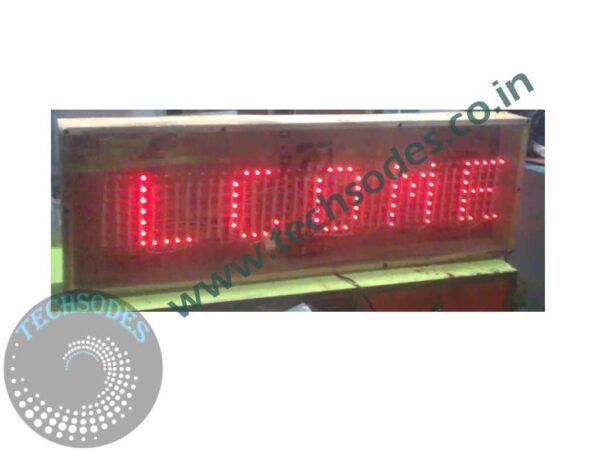
3.4 7?40 LED Matrix Display
- Consists of 7 rows and 40 columns of LEDs
- Used to display a single-line text message
- Can show the message either in static or scrolling format
- Designed to be bright and visible even from a distance
3.5 EEPROM
- Used to store the last valid SMS message
- Ensures message reappears automatically on power-up
- Either internal EEPROM of the PIC or external I2C EEPROM (like 24C04) can be used
3.6 Power Supply
- 5V regulated supply for microcontroller and GSM module
- Optional battery backup can be used for power-failure protection
4. Software Functionality
4.1 SMS-Based Message Control
- Users can send SMS from any phone to update the LED board
- Each SMS must begin with a password for authentication
- Only valid, password-authenticated messages are displayed
Example SMS:
#1234 Welcome to TechSodes
Here, #1234 is the password.
4.2 Scroll or Static Display
- The message can be displayed in scrolling or static format
- The format is controlled via SMS
Example commands:
#1234 MSG:Welcome to TechSodes(default scrolling)#1234 MODE:STATIC#1234 MODE:SCROLL
4.3 Scrolling Speed Control
- Scrolling speed can be set via SMS
Examples: #1234 SPEED:FAST#1234 SPEED:MEDIUM#1234 SPEED:SLOW
4.4 EEPROM Storage
- The microcontroller saves the last accepted SMS message into EEPROM
- If the device loses power, the message is reloaded from EEPROM on reboot
- This ensures that the board always shows a valid message even after blackouts
4.5 SMS Format Handling
- The system reads the SMS using AT commands
- Strips the message of extra characters or sender data
- Verifies password
- Parses and stores message content
- Sends acknowledgment (optional)
5. Workflow
- System starts ? Loads message from EEPROM and displays it
- GSM module waits for new SMS
- On receiving SMS:
- PIC reads the SMS
- Verifies password
- Extracts the message and optional commands (scroll/static, speed)
- Displays the message accordingly
- Saves the message to EEPROM
6. Applications
This system is ideal for:
- Shops and Retail Stores: Promotional messages, offers, timings
- Educational Institutes: Class updates, holidays, emergency alerts
- Religious Places: Bhajan lines, timings, visitor info
- Factories: Safety tips, line status, shift changes
- Residential Societies: Notices, announcements
- Small Offices or Clinics: Appointment status, availability, etc.
7. Key Benefits
- Remote Control: SMS-based control from any location
- Compact Design: Single-line 7?40 LED matrix fits in tight spaces
- Password Protection: Prevents unauthorized message display
- EEPROM Storage: Reliable data retention after power loss
- Flexible Display Options: User-controlled scrolling/static modes and speed
- Low Maintenance: No manual intervention required once installed
- Cost-Effective: Uses minimal components, suitable for mass deployment
8. Future Scope and Enhancements
This system can be expanded with:
- Android App Interface: A GUI-based app to send SMS commands easily
- Wi-Fi Module (ESP8266/ESP32): Enable internet-based remote control
- Multiple Language Support: Hindi, Punjabi, or other Unicode fonts
- Real-Time Clock: Schedule messages by time
- Multiple Message Slots: Rotate between different saved messages
- Voice Alert System: Audible alerts with message triggers
9. Conclusion
The 7?40 GSM-based LED notice board using PIC microcontroller is a compact, practical, and low-cost solution for remote text display. The system effectively combines microcontroller control, GSM communication, LED display handling, and EEPROM storage to build a reliable and remotely manageable notice board system. Its ability to control the display format and speed via SMS makes it highly user-friendly and adaptable to multiple scenarios. The password authentication feature enhances security, ensuring only authorized messages are displayed. Given its simplicity and flexibility, this project can serve as a valuable tool in enhancing digital communication in constrained environments.