Description
Abstract ? Advanced GSM-Based Energy Meter Reading with Load Control and Power Failure Alert System
1. Introduction
In the modern era of automation and communication technologies, manual collection of electricity meter readings has become outdated, inefficient, and error-prone. Traditional meter reading requires personnel to visit each consumer location, record readings manually, and then update them in the electricity board?s database. This process is not only labor-intensive but also susceptible to human errors, delays, and even fraudulent tampering.
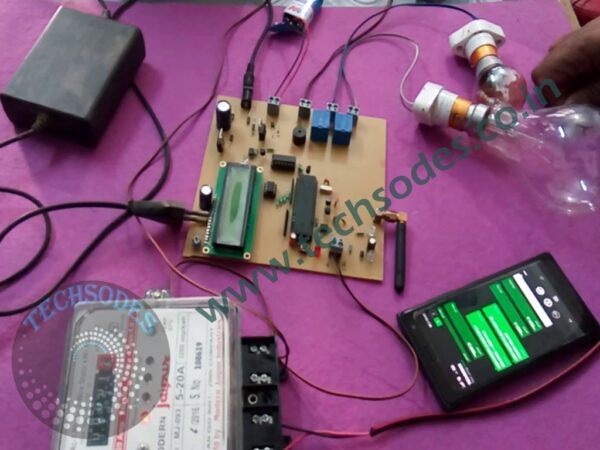
The Advanced GSM-Based Energy Meter Reading with Load Control and Power Failure Alert project introduces a smart, efficient, and fully automated solution to address these challenges. The system enables remote monitoring of domestic energy meters using GSM communication technology and provides advanced features such as load control (remote switching ON/OFF of connected appliances) and instant power failure alerts.
By integrating a microcontroller (AT89S52 / 8051 family) with an energy meter pulse counting mechanism, a GSM modem, EEPROM memory backup, and LCD display interface, the system provides an end-to-end platform for electricity consumption monitoring, user notification, and load management?all without the need for a meter reader to physically visit the premises.
2. System Overview
The proposed system continuously monitors the energy consumption by counting pulses from a standard electronic energy meter. Most modern meters provide an output pulse for a fixed amount of energy consumption (e.g., 3200 pulses per kWh). The microcontroller processes these pulses to calculate total energy consumed and displays the data on a 16?2 LCD screen.
Simultaneously, the GSM module communicates this reading to the electricity department?s central monitoring system or to the administrator?s registered mobile phone via SMS. Depending on the mode selected, the system can send readings periodically (every set interval) or monthly (on a fixed date).
Additionally, the system is equipped with a relay-based load control mechanism, enabling the administrator or user to send a predefined SMS command to remotely turn ON/OFF specific electrical loads. This is particularly useful for managing peak loads or disconnecting supply in case of overdue payments.
Finally, the power failure detection system ensures that whenever power is lost, the device immediately sends a power failure alert to the registered number, ensuring quick response from the utility provider or alerting the consumer.
3. Functional Modes
The system supports two main operational modes for meter reading transmission:
Mode 1 ? Interval-Based Reading Transmission
- The system is configured to send the current meter reading to the administrator?s number after every fixed count of pulses (e.g., every 10 CALS).
- This allows for near-real-time monitoring of energy consumption, making it suitable for environments where continuous supervision is required.
Mode 2 ? Monthly Scheduled Transmission
- The system sends the current meter reading once every month (e.g., on the 5th of each month).
- This mode is ideal for traditional billing cycles where readings are required once per billing period.
- The reading is stored in the electricity department?s database automatically without manual entry.
4. Hardware Components and Architecture
The system consists of the following major components:
- Microcontroller (8051 Family ? AT89S52)
- Acts as the central processing unit.
- Interfaces with the energy meter, LCD, GSM modem, EEPROM, and relay driver.
- Controls timing, pulse counting, message formatting, and system modes.
- Energy Meter Interface
- Utilizes the pulse output from a standard digital energy meter.
- Each pulse corresponds to a specific energy unit; the microcontroller counts these pulses to determine consumption.
- GSM Modem (SIM900 or similar)
- Sends and receives SMS messages.
- Operates via standard AT commands through UART (serial) communication with the microcontroller.
- 16?2 LCD Display
- Shows real-time meter readings, operational mode, load status, and alert messages.
- EEPROM (24C02 or similar)
- Non-volatile memory for storing meter readings and system configuration even during power cuts.
- Relay & Load Control Circuit
- Allows remote switching of connected electrical appliances via SMS commands.
- Uses a BC547 transistor as a driver for energizing the relay.
- Power Failure Detection Circuit
- Monitors the presence of mains voltage.
- On detecting power outage, triggers an immediate SMS alert via the GSM modem.
- Power Supply Unit
- Provides regulated 5V DC for the microcontroller and associated electronics.
- Includes transformer, bridge rectifier, filter capacitors, and voltage regulator IC (7805).
5. Working Principle
The energy meter generates pulses proportional to the amount of energy consumed. These pulses are fed into the microcontroller?s counter pin, where each increment updates the total energy consumed. The LCD continuously displays the updated reading.
The system continuously checks for SMS commands from the administrator. These commands can:
- Request the current meter reading.
- Switch ON/OFF a specific load connected to the relay output.
The system also runs a power failure detection routine. If mains supply is lost, the circuit instantly switches to backup power and sends an SMS alert about the outage. Similarly, when power is restored, it can optionally notify the administrator.
The EEPROM backup ensures that even during prolonged power failures, the stored reading is retained, preventing data loss.
6. Communication Flow
- Meter Reading Update Cycle
- Pulse detected ? Microcontroller count updated ? LCD display refreshed ? EEPROM updated.
- Scheduled SMS Transmission
- Timer interrupt triggers based on mode setting (interval/monthly) ? Reading retrieved from EEPROM ? GSM modem sends formatted SMS.
- Incoming Command Handling
- GSM modem receives SMS ? Microcontroller parses command ? Executes action (load ON/OFF or send reading).
- Power Failure Alert
- Supply loss detected ? Immediate SMS alert sent to registered number.
7. Advantages
- Automation of Meter Reading: Eliminates the need for manual visits to each consumer location.
- Accurate and Timely Data: Reduces human error and ensures timely updates.
- Load Control Feature: Gives utilities and consumers the ability to remotely manage connected loads.
- Power Failure Alerts: Ensures quick restoration efforts and prevents long outages going unnoticed.
- Non-Volatile Storage: Protects against data loss during power cuts.
- Cost Savings: Reduces manpower requirements and operational costs for utility providers.
- Security: Prevents tampering by monitoring power status and consumption trends.
8. Applications
- Electricity Boards & Utility Companies ? For automated meter reading and billing.
- Industrial Energy Monitoring ? For tracking power usage in factories and plants.
- Smart Homes ? For remote control of home appliances and monitoring of energy consumption.
- Remote Areas ? Where frequent manual meter reading is difficult.
- Commercial Complexes ? For centralized monitoring of multiple units.
9. Future Scope
This system can be further enhanced with:
- Prepaid Billing Systems: Automatically cut off load when credit runs out.
- IoT Integration: Send data to a cloud server for analysis and visualization.
- Mobile Application Support: Control loads and monitor usage through a smartphone app instead of SMS.
- Tamper Detection: Alert when attempts are made to bypass the meter.
- Real-Time Energy Pricing: Integrate with dynamic pricing models to optimize consumption.
10. Conclusion
The Advanced GSM Meter Reading with Load Control and Power Failure Alert project demonstrates a practical, scalable, and cost-effective solution for modernizing the energy monitoring and billing process. By leveraging the widespread GSM network, it enables real-time communication between the energy meter and the administrator without any manual intervention.
Its additional features?such as remote load control and instant power outage alerts?extend its usefulness beyond mere data collection, transforming it into a complete smart energy management system. This technology reduces operational costs, increases accuracy, enhances customer satisfaction, and paves the way for the future of smart grid integration.