
Description
Abstract
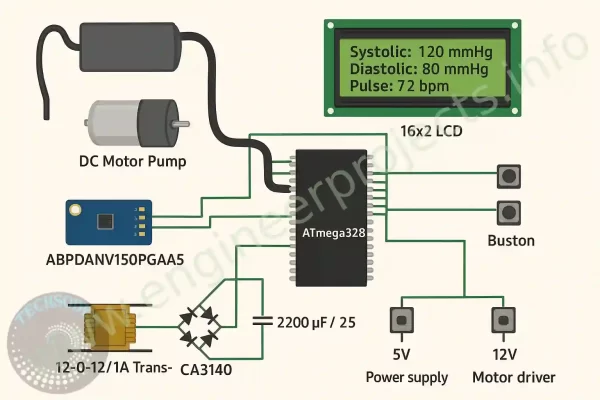
Blood pressure measurement is a vital physiological parameter for monitoring cardiovascular health, serving as an indicator of the force exerted by circulating blood on arterial walls. Traditional sphygmomanometers require manual operation and clinical expertise, whereas modern advancements in biomedical engineering have enabled the design of automated, portable, and cost-effective blood pressure monitoring devices. This project presents the development of a microcontroller-based blood pressure monitoring system using an ATmega328 microcontroller, CA3140 operational amplifier, ABPDANV150PGAA5 pressure sensor, blood pressure cuff with a DC motor pump, and other supporting electronic components such as the L293D motor driver, diodes (IN4007), 2200µF/25V capacitor, resistors, capacitors, push buttons, a 12-0-12/1A step-down transformer, and a 16×2 LCD display. The system is engineered to provide accurate systolic and diastolic blood pressure readings, along with real-time display output, offering both affordability and reliability for healthcare and personal monitoring applications.
System Overview
The project integrates multiple functional blocks:
- Sensor and amplification block (ABPDANV150PGAA5+ CA3140)
- Microcontroller data acquisition and processing (ATmega328)
- Motorized cuff inflation/deflation (DC pump + L293D)
- Power supply block (12-0-12V transformer, rectifier, capacitors, regulators)
- Display and user interface (16×2 LCD, push buttons)
The ABPDANV150PGAA5 pressure sensor detects cuff pressure variations, translating mechanical air pressure into corresponding electrical analog signals. Since the raw sensor output is weak and requires precise conditioning, the CA3140 operational amplifier is employed to amplify and stabilize the signal. The amplified signal is processed by the ATmega328 microcontroller, which executes analog-to-digital conversion (ADC), filtering, and algorithmic determination of systolic and diastolic pressures using oscillometric principles.
Power Supply Section (with 12-0-12/1A Transformer)
A reliable power supply is the backbone of the system. In this project, a 12-0-12/1A transformer is employed to step down the 230V AC mains into a safe low-voltage AC. The dual 12V AC output is rectified using 1N4007 diodes in a bridge rectifier configuration, providing pulsating DC. The 2200µF/25V capacitor smoothens this output by filtering ripples, ensuring a stable DC supply.
Voltage regulation is then applied:
- +5V DC for the ATmega328 microcontroller, LCD, and logic components.
- +12V DC for the DC motor pump, driven via the L293D motor driver.
This arrangement isolates high-current motor operations from sensitive digital electronics, ensuring stable operation. The transformer-based supply also provides durability, eliminating the frequent replacement issues associated with batteries. Moreover, the transformer design ensures electrical isolation from mains, enhancing user safety.
Signal Conditioning and Processing
The ABPDANV150PGAA5 pressure sensor acts as a transducer, converting mechanical cuff pressure into electrical variations. However, the raw output is in the millivolt range. The CA3140 BiMOS op-amp, known for its high input impedance and low noise, amplifies these signals into a measurable voltage range. After amplification, the signal is fed into the ADC pins of the ATmega328.
The ATmega328 microcontroller then performs digital filtering to reduce noise and applies the oscillometric method for pressure calculation:
- The systolic pressure is identified at the onset of oscillations.
- The mean arterial pressure (MAP) corresponds to the maximum oscillation amplitude.
- The diastolic pressure is found at the disappearance of oscillations.
The final processed values are displayed in real-time on the LCD.
Motor Control and Cuff Operation
The blood pressure cuff is inflated by a DC motor pump kit. Since the motor requires higher current than the microcontroller can supply, an L293D H-bridge motor driver is used. The L293D allows the ATmega328 to control motor direction and speed safely.
- During inflation, the cuff is pumped until pressure exceeds ~160–180 mmHg.
- Controlled deflation is then performed, during which the pressure oscillations are measured.
The motor driver is protected by flyback diodes within the L293D and external IN4007 diodes, preventing reverse currents. The 2200µF capacitor absorbs sudden current surges caused by motor switching, preventing microcontroller resets.
User Interface and Display
The 16×2 LCD serves as the output module. It provides clear alphanumeric information such as:
- “Inflating Cuff” during inflation.
- “Measuring…” during oscillometric analysis.
- Final results: Systolic: XXX mmHg, Diastolic: XXX mmHg, Pulse: XX bpm.
Push buttons are provided for user inputs, such as initiating or resetting measurements. The LCD makes the device intuitive even for non-technical users.
Calibration and Testing
Calibration is critical for biomedical devices. The ABPDANV150PGAA5 sensor output was compared with readings from a mercury sphygmomanometer, which served as the gold standard reference. The CA3140 gain was adjusted for linear response across the cuff pressure range (0–250 mmHg). Testing was performed on multiple subjects to ensure reliability.
Challenges included minimizing electrical noise, ensuring stable power under motor load, and filtering false oscillations due to motion. These were mitigated by:
- Using large-value capacitors in the power supply.
- Employing software-based digital filtering in the ATmega328.
- Implementing a controlled motor speed during deflation for accurate readings.
Advantages of the Design
- Low-cost implementation – Components such as ATmega328, CA3140, and L293D are inexpensive and easily available.
- Automation – Unlike manual devices, the cuff inflation/deflation is automatic.
- Portability – Compact and lightweight, suitable for home or clinic use.
- Accuracy – Uses oscillometric principle, reducing operator errors.
- Reliable Power – Transformer-based supply eliminates dependency on batteries.
Applications
- Home healthcare monitoring for patients with hypertension.
- Clinics and rural healthcare centers where cost-effective solutions are required.
- Educational use in biomedical instrumentation laboratories.
- Prototype basis for developing low-cost commercial medical devices.
Limitations
- Transformer-based design requires AC mains, limiting portability in mobile scenarios.
- ABPDANV150PGAA5 sensor, though functional, is less specialized compared to dedicated biomedical pressure sensors.
- Accuracy is slightly lower compared to FDA-approved commercial monitors, requiring further refinement.
Future Improvements
- Add a battery backup system for portable use.
- Implement wireless data transfer (Bluetooth/Wi-Fi) for remote health monitoring.
- Add an SD card module for data logging.
- Use advanced filtering algorithms (e.g., Kalman filter) for noise suppression.
Conclusion
This project successfully demonstrates the design and development of a low-cost automated blood pressure monitoring system using basic electronic components. The integration of an ATmega328 microcontroller with the CA3140 amplifier, ABPDANV150PGAA5 pressure sensor, L293D motor driver, and 16×2 LCD achieves accurate, automated, and user-friendly operation. The inclusion of a 12-0-12/1A transformer-based power supply ensures robustness and long-term reliability.
Through careful calibration, testing, and modular design, the system proves that accessible biomedical devices can be built without reliance on expensive commercial solutions. With further refinement, this project holds potential for deployment in real-world healthcare, especially in rural or resource-limited areas.


Reviews
There are no reviews yet.