
Description
Abstract: 16×128 GSM-Based LED Notice Board Using PIC18F4550
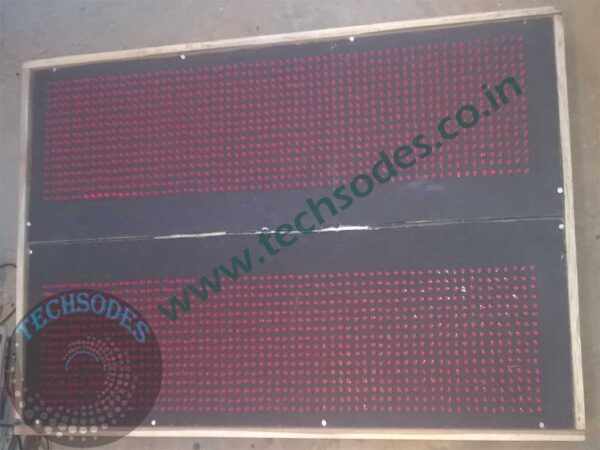
In the age of wireless communication and automation, efficient information dissemination plays a vital role across educational institutions, public transportation systems, commercial establishments, and government organizations. Traditional notice boards are gradually becoming obsolete due to their dependency on manual intervention. This project aims to modernize public communication through a GSM-based LED notice board system, enabling authorized users to remotely update the display via SMS. The entire system is powered by the PIC18F4550 microcontroller, integrated with a SIM800 GSM modem, 74LS595 shift registers, and a dual-line 16?64 LED matrix, creating a combined display resolution of 16×128 pixels.
1. Introduction
The aim of this project is to develop a remote, password-protected LED display system that can display messages received via SMS and save them for persistent display. Unlike conventional boards, this system allows wireless message updates, remote configuration, and data retention even after power loss. It features a two-line 16?64 LED display, and each line can show different messages simultaneously. The system also supports reconfiguration through SMS commands and ensures that only authenticated users can control the display content.
This embedded solution is cost-effective, low-power, reliable, and easily deployable across diverse sectors, such as schools, offices, bus stands, railway stations, and hospitals.
2. System Overview
The system consists of the following core components:
- Microcontroller (PIC18F4550) for logic control
- SIM800 GSM Module for SMS communication
- 74LS595 Shift Registers for LED matrix driving
- 16?64 LED displays (two lines)
- EEPROM for saving the last valid SMS message
- Power supply unit
The GSM module receives SMS messages, which are verified using a password scheme. Upon successful authentication, the message is decoded and displayed on the LED matrix. The message is also saved to EEPROM, allowing it to reappear automatically after a power cut.
3. Hardware Components
3.1 PIC18F4550 Microcontroller
The PIC18F4550 is an 8-bit high-performance microcontroller with 32KB flash, 2KB RAM, and onboard EEPROM. It controls the entire system including:
- UART communication with SIM800
- Parallel data transmission to shift registers
- Message parsing and verification
- EEPROM read/write
3.2 SIM800 GSM Modem
The SIM800 is a quad-band GSM module that supports SMS, GPRS, and voice calling. In this project:
- SMS is received via mobile network
- AT commands are used to read and delete messages
- Communication with the MCU is done over UART (9600 baud)
3.3 74LS595 Shift Register (Latch)
These are serial-in, parallel-out shift registers that expand I/O capabilities of the microcontroller. Each LED line (16?64) requires multiple shift registers daisy-chained to handle 64 columns.
3.4 16?64 LED Display (?2)
- Each display has 16 rows and 64 columns of LEDs.
- Two such lines are used, placed one above the other, forming a 16×128 total display.
- They can display two independent messages or a single scrolling message across the full display.
3.5 EEPROM
- Internal EEPROM of PIC is used for storing the latest valid SMS.
- Ensures that the message is retained even if power is lost.
- Upon restart, the message is reloaded and displayed automatically.
3.6 Power Supply
- Standard regulated 5V supply
- Provision for backup (optional battery or UPS) to maintain uninterrupted functionality
4. Software Features
4.1 SMS Authentication
All commands or messages must begin with a pre-set password (e.g., #1234) for verification. Only verified messages are displayed.
Example:
#1234 Welcome to Techsodes!
If the password is incorrect, the message is ignored.
4.2 Display Modes
- Dual-line Mode: Each 16?64 line displays a different message.
- Full-line Mode: Combines both lines to show one continuous message on 16×128.
Switching between modes can be done via SMS command.
4.3 SMS Configuration Commands
Users can send specific SMS commands to update messages or control behavior.
Examples:
#1234 LINE1: Welcome!#1234 LINE2: Stay Safe#1234 MODE:DUALor#1234 MODE:SINGLE#1234 SPEED:FAST#1234 CLEAR? clears the display and EEPROM
4.4 EEPROM Handling
- Saves last valid message
- Automatically loads and displays the saved message on power-up
- Protects data integrity using checksum (optional)
4.5 UART Communication
- Full-duplex communication between GSM and microcontroller
- AT command parsing and acknowledgment handling
5. System Workflow
- The system powers on and checks the EEPROM.
- If a message is saved, it is displayed immediately.
- SIM800 waits for incoming SMS.
- Upon receiving SMS:
- MCU reads SMS using AT commands.
- Validates password.
- Parses command or message content.
- Displays the message on the LED screen.
- Saves it to EEPROM.
In case of a power outage, the system resets and reloads the last displayed message from EEPROM.
6. Applications
- Colleges and Schools ? Announcements and real-time updates
- Hospitals ? Doctor availability or patient information
- Factories ? Shift timings or safety messages
- Railway/Bus Stations ? Timetables or emergency alerts
- Offices ? Notices, alerts, or motivational messages
- Shops/Markets ? Promotions or advertisements
7. Advantages
- Wireless Operation: Full control via SMS, no physical presence needed
- Cost-effective: Uses commonly available components
- Modular: Can add more shift registers for larger display sizes
- Reliable: EEPROM ensures data retention after power loss
- Flexible: Can show different messages on both lines
- Secure: Password-protected control to avoid misuse
- User-friendly: Settings can be changed by simple SMS commands
8. Future Enhancements
- Android App: Simplify sending SMS via a GUI app
- Multilingual Display: Add support for Hindi, Punjabi, etc., using Unicode fonts
- Voice Alerts: Add audio feedback module
- Real-Time Clock (RTC): Time-based message scheduling
- Internet Control: Add Wi-Fi module (ESP8266/ESP32) for cloud-based updates
- Message Logging: Store multiple messages with time-stamps
9. Conclusion
The 16×128 GSM-Based LED Notice Board using PIC18F4550 provides a powerful yet affordable way to modernize public information systems. The ability to control the display via SMS, authenticate commands, store messages, and automatically restore display after power failures makes this system highly reliable and suitable for deployment in diverse fields.
The dual-line 16?64 configuration allows for efficient space usage and message segregation. With a focus on real-world applications, the design is easy to replicate, scalable, and offers strong potential for future upgrades like multilingual support and IoT-based cloud integration.



Reviews
There are no reviews yet.