
Description
Arduino-Based Pedometer Using Bluetooth and Android
Abstract
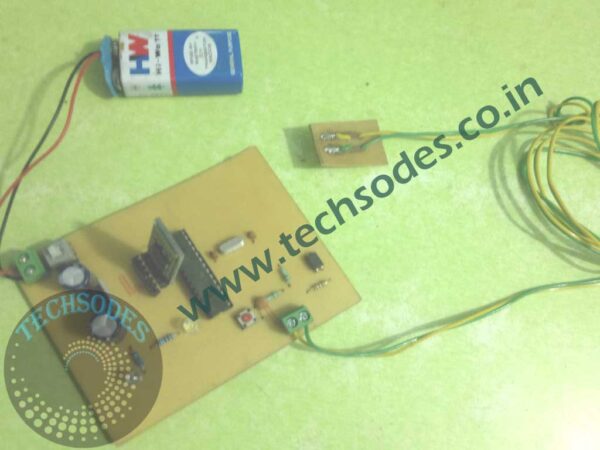
This project focuses on the design and implementation of a highly accurate, Arduino-based pedometer that uses a mechanical push-button sensor instead of conventional accelerometer-based motion detection. The primary objective of this design is to eliminate the inaccuracies found in traditional pedometer devices that rely on accelerometer algorithms, which often misinterpret small vibrations or irregular movements as steps. By integrating a push-button mechanism directly into the shoe sole, the system is able to detect only genuine steps, providing a true mechanical count for superior accuracy.
The project incorporates an ATmega328 microcontroller, HC-05 Bluetooth module, and a mechanical step sensor (push button module) that is physically mounted inside the shoe. Every time the user takes a step, the push button is pressed momentarily, sending a clear and unambiguous pulse to the microcontroller. This signal is then processed and the step count is incremented by exactly one.
In addition to counting steps in real time, the system stores the complete step data in the internal EEPROM of the microcontroller, allowing long-term record keeping even if the device loses power. The data can be accessed at any time by pairing the pedometer with an Android application via Bluetooth, enabling the user to view both live step counts and historical walking data.
The entire device is powered by a 9V battery, regulated through a 7805 voltage regulator with smoothing provided by a 2200?F/25V capacitor, ensuring stable operation of the microcontroller and other electronics. The design also includes resistors for proper signal conditioning. This compact, portable, and energy-efficient pedometer can be easily mounted on any shoe, making it an ideal wearable device for fitness tracking, rehabilitation programs, and sports training.
Introduction
Walking is one of the most effective and natural forms of exercise. To monitor daily walking activity, pedometers have become a popular tool among fitness enthusiasts. However, most commercially available pedometers use accelerometer-based motion detection and complex algorithms to estimate steps. These systems often suffer from false counts caused by foot vibrations, uneven surfaces, or minor body movements, resulting in unreliable readings.
The proposed system solves this problem by using a mechanical step-detection approach. A push-button is installed inside the user?s shoe in such a way that it is pressed only when a complete step is taken. This ensures 100% accuracy in step counting compared to algorithmic approaches.
The microcontroller records each step and stores it in internal EEPROM for permanent logging. A Bluetooth module provides wireless connectivity, enabling the step data to be viewed on an Android smartphone in real-time or accessed later. This system is therefore more reliable, user-friendly, and precise than conventional pedometers.
System Overview
The system is divided into four main functional blocks:
- Step Detection Module
- A push-button sensor is placed inside the shoe sole.
- The button is positioned such that it gets pressed only when the user?s heel strikes the ground fully during a walk or run.
- Each press generates a clean electrical pulse.
- Processing Unit
- The ATmega328 microcontroller processes the input pulses from the push button.
- Each valid pulse increments the step counter by one.
- The microcontroller also stores the total count in its EEPROM to retain data during power loss.
- Wireless Communication
- The HC-05 Bluetooth module provides a wireless interface to communicate with an Android application.
- The user can request stored data or monitor real-time step counts directly on their phone.
- Power Supply
- A 9V battery powers the system.
- A 7805 voltage regulator ensures a constant 5V supply to the microcontroller, Bluetooth module, and push-button circuit.
- A 2200?F capacitor smooths voltage fluctuations for stable performance.
Working Principle
Step Detection
Unlike accelerometer-based pedometers that measure motion in three axes and run algorithms to estimate steps, this system uses a mechanical method. The push-button acts as a simple, on/off step sensor. When the user steps down, the button is pressed, generating a digital ?high? signal to the microcontroller.
Pulse Processing
The microcontroller continuously scans the push-button input pin. Each time the signal transitions from ?low? to ?high? and back to ?low,? it is recognized as a valid step. The firmware includes debouncing logic to prevent multiple counts for a single press due to vibrations.
Data Storage
Every incremented step count is immediately saved into the internal EEPROM of the ATmega328. This allows the step count to persist even after the system is turned off or the battery is removed.
Bluetooth Transmission
The HC-05 Bluetooth module is paired with an Android smartphone. Through a custom Android application, the user can:
- View live step count updates
- Retrieve historical data from EEPROM
- Reset the step counter if needed
The communication between the microcontroller and HC-05 is done via UART protocol at a standard baud rate of 9600 bps.
Advantages of Mechanical Detection Over Accelerometer-Based Systems
- Higher Accuracy ? Only actual footfalls trigger a count, avoiding errors caused by random movements.
- Lower Complexity ? No complex algorithms or calibration needed.
- Lower Power Consumption ? Push-button detection consumes negligible current compared to accelerometers.
- Cost-Effective ? Uses inexpensive components without sacrificing performance.
- Longer Battery Life ? Minimal sensor power usage allows weeks of operation on a single 9V battery.
Features
- Real-time step count display via Android app
- Permanent step count storage in EEPROM
- Wireless data transfer using Bluetooth
- Highly accurate step detection using push-button mechanism
- Battery-powered portable design
- Low power consumption for extended battery life
- Simple and reliable operation with minimal calibration
Applications
- Personal Fitness Tracking ? For individuals who want accurate daily walking measurements.
- Rehabilitation Programs ? Patients recovering from leg injuries can track steps for therapy.
- Sports Training ? Athletes can monitor running performance without false counts.
- Senior Health Monitoring ? Track mobility in elderly individuals.
- Research Studies ? Accurate step data collection for health research.
Component List
| Component | Quantity | Description |
|---|---|---|
| ATmega328 MCU | 1 | Main controller |
| HC-05 Bluetooth | 1 | Wireless communication |
| Push Button | 1 | Step detection sensor |
| 9V Battery | 1 | Power source |
| 7805 Regulator | 1 | Voltage regulation |
| 2200?F Capacitor | 1 | Power smoothing |
| Resistors | Various | Signal conditioning |
| Connecting Wires | As req. | Electrical connections |
Power Supply Design
The 9V battery output is regulated to 5V using the 7805 IC. The 2200?F capacitor acts as a filter to smooth any ripple from the battery, ensuring steady voltage to the microcontroller and Bluetooth module. Resistors are used to prevent overcurrent conditions and protect the microcontroller pins.
Android Application Features
The Android app designed for this project connects to the HC-05 module over Bluetooth. It provides:
- Real-time step count display
- Option to reset counter
- History view (previous step counts stored in EEPROM)
- Battery status indicator (optional)
Future Scope
- Distance and Calorie Calculation ? Adding user height and weight data to estimate calories burned.
- GPS Integration ? Track walking routes via smartphone GPS.
- Waterproof Design ? For outdoor and sports use in all weather.
- Rechargeable Battery ? Replace 9V battery with Li-ion cell and charging circuit.
- OLED Display ? Direct step display without smartphone connection.
- Multi-User Support ? Assign different data profiles for multiple users.
Conclusion
This Arduino-Based Pedometer provides a simple, robust, and highly accurate method for step counting by replacing unreliable accelerometer-based detection with a mechanical push-button system. The use of Bluetooth connectivity and EEPROM storage makes the device versatile and user-friendly, allowing users to track both real-time and historical walking data via an Android smartphone.
The compact design, low cost, and high accuracy make this project a perfect fit for fitness enthusiasts, athletes, and medical monitoring applications. By focusing on a mechanical detection method, the system offers true step count accuracy unmatched by traditional pedometers.


Reviews
There are no reviews yet.