

Description
Abstract
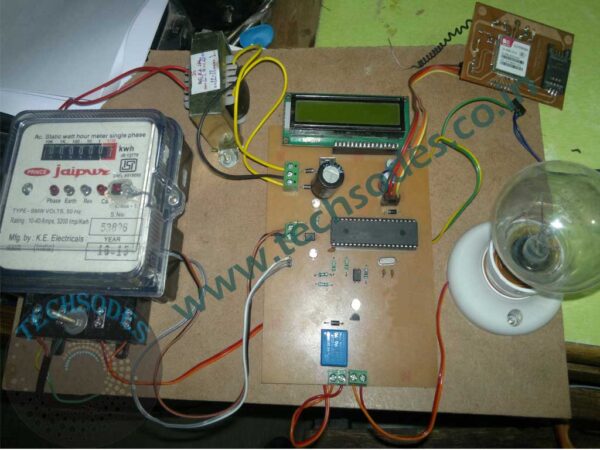
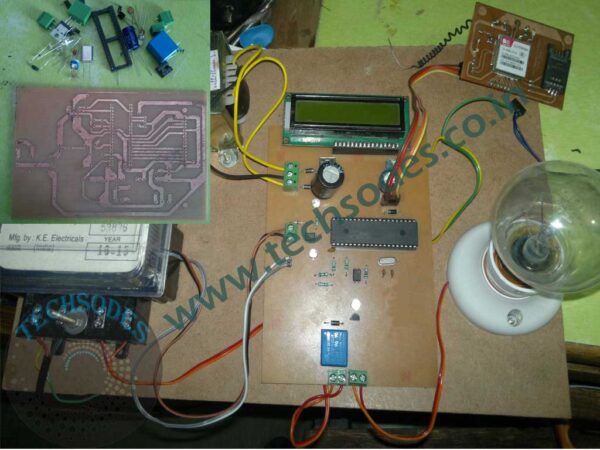
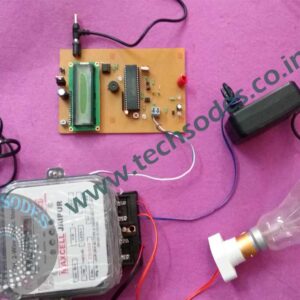
This project presents the design and implementation of an Advanced GSM-Based Energy Meter Reading and Load Control System with Theft Detection using a PIC18F4550 microcontroller. The system is designed to improve the transparency, reliability, and security of electricity billing and consumption monitoring. Traditional metering methods involve manual reading, which are prone to delays, inaccuracy, and human error. This project eliminates manual involvement by incorporating GSM communication, EEPROM data logging, relay-based load control, and tamper detection logic. These features ensure that energy consumption is monitored in real-time, transmitted remotely, and protected against unauthorized access or electricity theft.
System Overview
The heart of the system is the PIC18F4550 microcontroller, a powerful and feature-rich MCU from Microchip?s 8-bit family. It comes with inbuilt USB support, ADC, EEPROM, and multiple I/O ports, making it suitable for embedded automation. The energy meter’s call LED pulses, which indicate energy consumption (usually 3200 pulses per kWh), are optically isolated using a PC817 optocoupler. Each pulse from the LED corresponds to a fraction of a unit consumed and is counted accurately by the microcontroller to calculate total consumption.
The system uses a second PC817 optocoupler in conjunction with a BC547 NPN transistor to monitor and control the electrical load via a relay module. This circuit allows the system not only to disconnect or reconnect the load remotely via SMS command but also to detect tampering attempts, such as manual jumper connections to bypass the relay. If such a condition is detected (i.e., the load is drawing power without authorization), the microcontroller identifies it as a theft attempt and disables the load permanently while sending an alert via GSM.
Display and User Feedback
A 16×2 LCD is used to display real-time energy units, system status, relay/load status (ON/OFF), and warning messages in case of detected tampering or data errors. The LCD offers clear and continuous visual updates to the user. Additionally, a buzzer is integrated for feedback during configuration changes or fault alerts, such as unauthorized SMS commands, EEPROM access issues, or theft detection.
GSM Communication and Remote Access
The project includes a SIM800 GSM modem, which allows the system to communicate over the mobile network using SMS. The microcontroller sends the current meter reading and load status to the user?s mobile number at predefined intervals or upon request. All critical system parameters, including unit cost, admin and user numbers, load status, and security password, can be modified via SMS-based commands, which are strictly password protected. Unauthorized commands are rejected, and the sender is notified accordingly.
This remote control functionality allows both monitoring and management from distant locations, eliminating the need for physical access to the meter.
Data Storage and EEPROM Handling
The system utilizes the internal EEPROM of the PIC18F4550 to store vital parameters, including:
- Total energy units consumed
- Unit price per kWh
- Admin and user mobile numbers
- Security password
- Relay/load status (on/off)
- Tamper detection status
The non-volatile nature of EEPROM ensures that all critical data is preserved even in the case of a power failure. Upon reboot, the system reloads the saved state, making the system fault-tolerant and highly reliable for real-time applications.
Working Principle
- Pulse Sensing:
The call LED of the energy meter blinks for every unit fraction consumed. These pulses are optically isolated using a PC817, which sends each pulse to the microcontroller as a countable digital signal. - Real-Time Counting:
The microcontroller counts each pulse and calculates the total energy consumption. This data is continuously updated on the LCD and stored in EEPROM. - Load Monitoring and Relay Control:
A second PC817 optocoupler and BC547 transistor are used to control a relay, which acts as a physical switch to connect/disconnect the load. The relay?s status can be controlled remotely through SMS. - Theft Detection:
If the user manually bypasses the relay to power the load without proper SMS authorization, the system detects abnormal power consumption despite the relay being OFF. This mismatch between meter pulses and load state triggers a theft alert, disables the load, and sends an SMS to the admin. - SMS Communication:
The GSM module transmits energy readings to the user and listens for SMS commands. Only authenticated messages (verified by password) are executed. - EEPROM Persistence:
All major changes or readings are periodically saved in EEPROM to retain data even after power interruption.
Features and Functionalities
- Real-time energy unit counting using energy meter LED pulses
- GSM-based SMS reporting of energy usage
- Relay-controlled load switching with secure remote commands
- Dual optocoupler protection for energy sensing and relay monitoring
- BC547 transistor-based relay driver
- Automatic theft detection via bypass attempt monitoring
- 16×2 LCD for user-friendly display of readings and alerts
- Internal EEPROM usage for reliable data logging
- Password-protected SMS control
- Buzzer alerts for operation feedback and tampering
Advantages
- Eliminates need for manual meter reading and billing
- Enables remote control and real-time alerts
- Provides theft detection and secure power delivery
- Supports SMS-based configuration and updates
- Stores historical data even after power failures
- Simple and cost-effective design using common components
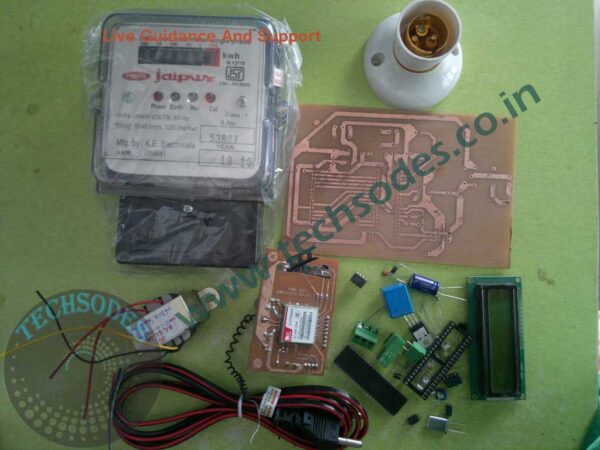
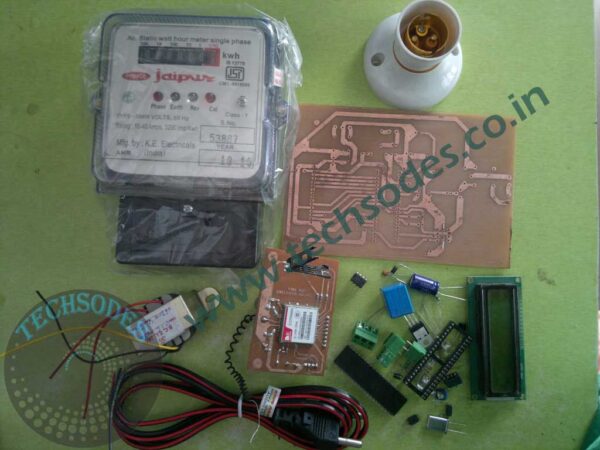
Hardware Components Used
| Component | Description |
|---|---|
| PIC18F4550 | 8-bit MCU with internal EEPROM and USB support |
| PC817 (x2) | Optocouplers for isolation and input detection |
| BC547 | NPN transistor used to drive the relay |
| Relay (12V SPDT) | Controls load ON/OFF status |
| SIM800 GSM Module | For SMS communication |
| 16×2 LCD | Display for units, status, alerts |
| Buzzer | Audio feedback for alerts |
| Power Supply Circuit | Transformer, diodes, capacitors, and 7805 regulator |
Applications
- Smart home and building electricity management
- Industrial load monitoring with theft detection
- Government electricity boards for automated billing
- Remote area metering where manual access is difficult
- IoT-based future upgrades for energy monitoring
Future Enhancements
- Integration with IoT platforms for real-time web dashboards
- Adding energy load profiling using current sensors
- Mobile App or Web Interface for enhanced UI
- Integration of Real-Time Clock (RTC) for timestamped logs
- Multi-phase version for industrial applications
Conclusion
The GSM-Based Energy Meter with Load Control and Theft Detection using PIC18F4550 offers a smart, scalable, and secure solution for modernizing energy monitoring and billing infrastructure. By combining embedded control, opto-isolation, GSM communication, and relay automation, this system not only delivers accurate real-time metering but also adds an intelligent layer of tamper detection and remote configuration. It empowers users and utility providers with better control, transparency, and accountability in energy usage ? a significant step forward in smart grid technology.


Reviews
There are no reviews yet.