
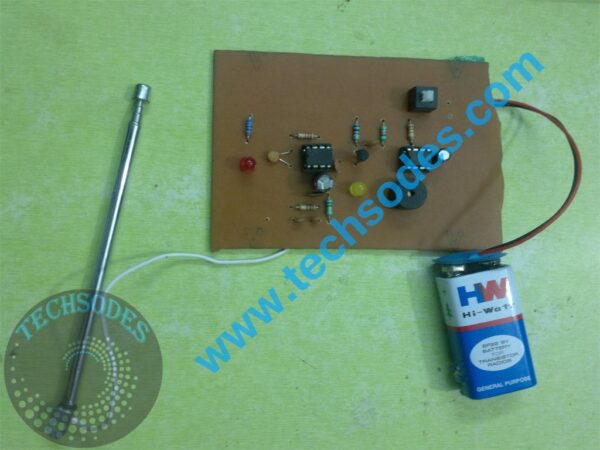
Description
Abstract – Mobile Bug ? Cell Phone Detector
The Mobile Bug is a compact and efficient electronic device designed to detect the presence of active mobile phones within a specified range. It works by sensing the radio frequency (RF) transmission signals emitted by mobile phones during active communication, such as during incoming or outgoing calls, SMS, or data/video transmission. The detection is effective even when the mobile phone is in silent mode, making it suitable for use in environments where mobile phone usage is restricted or needs to be monitored.
The device is particularly useful in preventing mobile usage in examination halls, confidential meetings, defense establishments, religious places, and hospitals, where mobile signals can be either a source of distraction, a breach of confidentiality, or a potential source of electromagnetic interference.
The updated version of the Mobile Bug in this project has specific detection ranges based on the communication network standard:
- 2G Networks ? Effective detection range up to 3 meters
- 3G Networks ? Effective detection range up to 1.5 meters
- 4G Networks ? Effective detection range less than 1 meter
When the Mobile Bug detects RF activity from an active phone within its range, it activates a beep alarm and flashes an LED indicator to alert the user. The alarm continues as long as the phone is actively transmitting.
1. Introduction
In today?s digital era, mobile phones have become an integral part of daily life. While beneficial, unrestricted mobile usage can sometimes be problematic, especially in locations where privacy, security, or discipline is a concern. This is where a mobile detection system becomes valuable.
The Mobile Bug serves as a portable, low-cost solution to detect active mobile phones. Unlike mobile jammers that block communication (and are subject to legal restrictions in many countries), this device simply detects active transmissions and alerts the user, without disrupting network services.
2. Principle of Operation
Mobile phones communicate with cell towers using RF signals at different frequencies depending on the network standard:
- 2G (GSM) ? 900 MHz and 1800 MHz bands
- 3G (WCDMA/UMTS) ? 2100 MHz band
- 4G (LTE) ? 700 MHz to 2600 MHz range
Whenever a mobile phone initiates or receives a call, sends an SMS, or uses mobile data, it transmits short bursts of RF energy. The Mobile Bug detects these bursts through a high-gain tuned RF amplifier circuit and triggers an alarm system.
The detection capability varies because:
- Lower-frequency 2G signals travel farther, giving a longer detection range (~3 meters).
- Higher-frequency 3G and 4G signals attenuate faster, resulting in reduced detection ranges (~1.5 m for 3G and <1 m for 4G).
3. System Components
The Mobile Bug consists of the following main parts:
3.1 RF Sensing Section
- High-Frequency Capacitor & Inductor Network: Tuned to pick up mobile phone transmission frequencies.
- Small Antenna (Wire or PCB trace): Captures ambient RF signals for processing.
3.2 Amplifier Section
- Transistor-Based Amplifier Stages: Typically using three high-frequency NPN transistors connected in a cascading configuration to boost weak RF signals.
3.3 Detection Circuit
- Diode Detector & Filter: Converts the RF signal into a low-frequency voltage variation suitable for triggering the alarm.
3.4 Alarm & Indicator
- Buzzer: Emits a beeping sound when RF activity is detected.
- LED Indicator: Flashes in synchronization with the RF bursts.
3.5 Power Supply
- A small battery (9V or rechargeable Li-ion) powers the unit, making it portable.
4. Working Principle
- Signal Capture:
The antenna picks up RF signals emitted by mobile phones when they are active. - Signal Amplification:
The RF signal is weak, so it passes through three transistor amplifier stages to increase its strength. - Detection:
The amplified signal is rectified and filtered to detect the RF burst pattern typical of mobile transmissions. - Triggering the Alarm:
If a burst is detected, the circuit activates the buzzer and LED. The alarm continues for the duration of the RF transmission. - Reset:
Once the phone stops transmitting (call ends or data transfer stops), the alarm ceases automatically.
5. Performance Based on Network Standard
| Network Type | Frequency Band | Typical Range in Mobile Bug |
|---|---|---|
| 2G GSM | 900 / 1800 MHz | Up to 3 meters |
| 3G UMTS | 2100 MHz | Up to 1.5 meters |
| 4G LTE | 700?2600 MHz | Less than 1 meter |
The difference in range is due to signal wavelength, power output, and encoding schemes used in higher-generation networks.
6. Applications
- Examination Halls: To catch students trying to use mobile phones for cheating.
- Confidential Meetings: To prevent secret recording or data transmission.
- Defense and Security: For preventing leaks of sensitive information.
- Hospitals: To avoid interference with sensitive medical equipment.
- Libraries & Religious Places: For ensuring silence and discipline.
- Parental Monitoring: Detects if teens are using phones at inappropriate times.
7. Advantages
- Low Cost & Portable: Easy to carry and use anywhere.
- Silent Mode Detection: Works even if the phone is in vibration or silent mode.
- No Interference with Calls: Only detects, does not block communication.
- Multi-Network Compatibility: Works with 2G, 3G, and 4G.
8. Limitations
- Limited Range for 4G: Due to higher frequency attenuation.
- Cannot Detect Powered-Off Phones: Works only when the device is actively transmitting.
- False Triggers Possible: Strong RF sources nearby may cause occasional false alarms.
9. Future Enhancements
- Increased Detection Range: Using more sensitive RF front-end circuits.
- Directional Antennas: To locate the source of transmission.
- Digital Signal Processing (DSP): To distinguish between network generations and reduce false alarms.
- Battery Optimization: Longer operating life for field use.
10. Conclusion
The Mobile Bug Cell Phone Detector is a practical and economical tool for environments where mobile phone use is prohibited or needs to be monitored. The updated design takes into account network frequency differences, providing maximum range for 2G (3 meters), moderate range for 3G (1.5 meters), and shorter range for 4G (<1 meter). Despite these differences, it remains an effective tool for RF-based mobile detection in various scenarios where security, privacy, and discipline are a priority.



Reviews
There are no reviews yet.